
Depression in Men: Why It Looks Different and Why It So Often Goes Undiagnosed
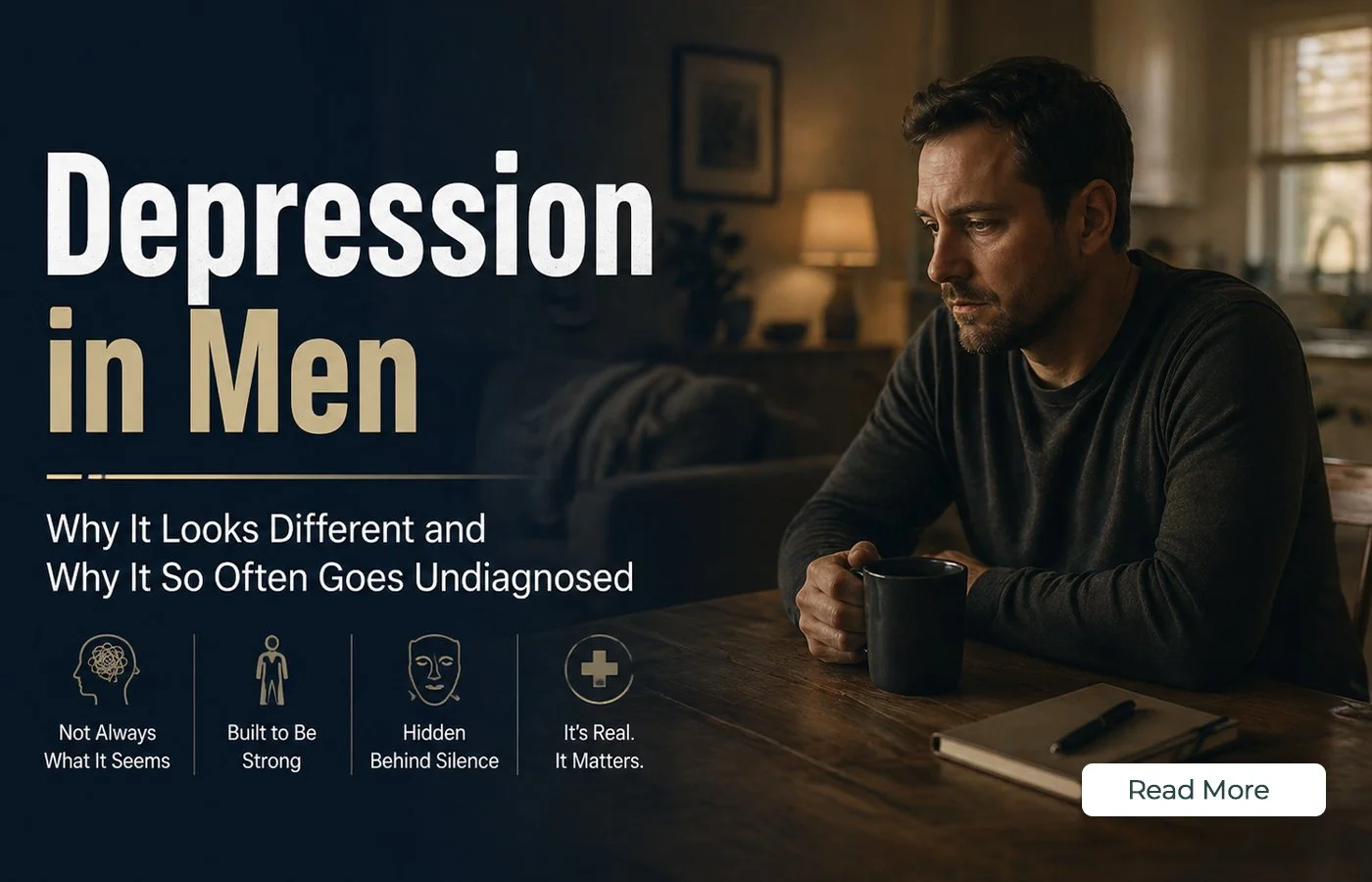
He goes to work every day. He provides for his family. He shows up when people need him. From the outside, everything looks completely normal.
But something has shifted. He is shorter tempered than he used to be. He has stopped watching the game on weekends, not because he is busy, but because he just does not feel like it anymore. He is drinking a little more than usual. He snaps at the people he loves and then feels genuinely terrible about it. He is tired in a way that a good night of sleep does not seem to fix.
Nobody around him would describe him as depressed. He would not describe himself that way either.
But that is exactly what is happening.
Depression in men is one of the most underrecognized mental health challenges today. Not because it is rare, but because it rarely looks the way most people expect depression to look. It does not always show up as sadness and tears. In men, it often wears a completely different disguise. And that disguise is convincing enough to fool everyone, including the man experiencing it.
This article will walk you through what depression in men actually looks like, the signs that are easy to miss, why it goes undiagnosed so often, and what can be done about it.
What Depression Actually Is and Why It Does Not Look the Same in Everyone
Depression is more than feeling sad. It is a medical condition that affects how a person thinks, feels, and functions in daily life. It drains energy, disrupts sleep, removes pleasure from things that used to bring it, and creates a persistent heaviness that does not lift on its own.
Most people picture depression as a person who cannot get out of bed, who cries frequently, and who openly expresses that they are struggling. That picture is real for some people. But it is far from the only way depression shows up.
Depression presents differently depending on the person, and a significant number of factors shape how it expresses itself. Age, personality, life circumstances, cultural background, and yes, gender all influence what depression looks and feels like in practice.
In men specifically, the combination of how depression presents biologically and how men are socially conditioned to handle emotional distress creates a pattern that looks almost nothing like the standard description. That gap between expectation and reality is the reason male depression symptoms are missed so frequently, by doctors, by loved ones, and by men themselves.
Why Depression in Men Looks Different
The difference is not simply that men are less emotional. It is that men are more likely to externalize their distress rather than internalize it. Where a woman experiencing depression might turn the pain inward and express it through sadness, withdrawal, or tearfulness, a man is more likely to direct that same pain outward through behavior, physical complaints, or emotional redirection.
This distinction matters enormously when it comes to recognizing what is actually happening.
The Role of Societal Expectations
From a very young age, most men receive clear and consistent messaging about how they are supposed to handle difficulty. Be strong. Push through. Do not complain. Handle it yourself. Showing vulnerability is weakness. Emotional pain is something to be managed privately, if at all.
These messages do not disappear when a man grows up. They become deeply embedded in how he relates to his own inner experience. When depression starts to develop, the response is not to recognize it and talk about it. The response is to push harder, stay busier, and keep the lid on whatever is building underneath.
Emotional Conditioning From an Early Age
Boys are frequently discouraged from expressing fear, sadness, or emotional pain in the way girls are allowed to. This does not mean boys feel these things less. It means they learn early that expressing them carries social consequences. They learn to redirect, suppress, or transform those emotions into something more acceptable.
By the time a man reaches adulthood, the habit of not acknowledging emotional pain is so deeply practiced that it happens automatically. He is not consciously hiding his depression. He genuinely may not recognize it as depression because he has spent decades not having the language or the permission to describe what he feels inside.
Common Signs of Depression in Men That Are Easy to Miss
This is where recognition begins. The following signs of depression in men are frequently overlooked because they look like personality traits, stress responses, or lifestyle habits rather than symptoms of a mental health condition.
Emotional and Psychological Signs
Irritability and a shorter temper than usual. One of the most common and least recognized signs of depression in men is increased irritability. Rather than expressing sadness, many men experience depression as a constant low-level frustration that spills out as anger or impatience toward the people around them.
Feeling empty or flat without being able to explain it. Not sadness exactly. More like a muted, colorless version of life where nothing feels particularly meaningful or engaging. Men often describe this as just feeling off without being able to say why.
Loss of interest in things that used to matter. Hobbies get abandoned. Sports he used to follow feel pointless. Social plans get canceled. The activities that used to bring genuine pleasure simply stop appealing.
Difficulty concentrating or making decisions. Work tasks that used to feel manageable become harder to focus on. Decision-making feels unusually draining. Small things require more mental effort than they should.
A growing sense of hopelessness framed as realism. Rather than saying he feels hopeless, a man with depression might say things like "that is just how life is" or "things never really work out anyway." The hopelessness is real but it gets dressed up as a practical worldview.
Behavioral Signs
Withdrawing from family and friends. He stops engaging in conversations. He is present physically but absent emotionally. He creates distance without explaining it and often without fully understanding why himself.
Overworking to stay busy. Throwing himself into work is a way of avoiding the internal experience of depression. Staying constantly occupied means not having to sit with the discomfort of what is actually happening inside.
Increased alcohol or substance use. Using alcohol, cannabis, or other substances to take the edge off is extremely common in men with undiagnosed depression. It provides temporary relief from the emotional weight while the underlying condition continues to build.
Risk-taking or impulsive behavior. Reckless driving, impulsive financial decisions, or other out-of-character risk-taking can be a sign that a man is seeking sensation or stimulation to break through the numbness depression creates.
Aggression or conflict in relationships. Partners and family members often notice the man becoming harder to be around. Arguments become more frequent. Small frustrations escalate disproportionately. This is often a sign of the emotional pain looking for somewhere to go.
Physical Signs
Persistent fatigue without a clear cause. A bone-deep tiredness that does not improve with rest. The body is carrying the weight of the emotional experience even when the mind is not acknowledging it.
Unexplained physical complaints. Headaches, back pain, digestive issues, and general physical discomfort that have no obvious medical explanation are frequently how depression expresses itself in men who are not processing it emotionally.
Changes in sleep patterns. Either sleeping far more than usual as a way of escaping, or lying awake at night with a mind that will not quiet down.
Changes in appetite or weight. Either eating significantly more or significantly less than usual, often without much awareness that it is happening.
Why Depression in Men Goes Undiagnosed So Often
Knowing the signs is only part of the picture. Understanding why they so often go unrecognized is equally important.
Stigma Around Mental Health and Masculinity
For many men, admitting to a mental health struggle feels like admitting to a fundamental failure of character. The cultural equation of masculinity with emotional toughness creates a powerful barrier. Seeking help feels like confirming a weakness rather than addressing a medical condition.
Symptoms Get Misread as Something Else
Irritability gets labeled as a bad attitude. Withdrawal gets read as introversion. Overworking gets praised as dedication. Physical complaints get investigated medically without anyone asking about mood. The symptoms are visible but they get interpreted through the wrong lens, which means the underlying depression stays hidden.
Men Are Less Likely to Seek Help Early
Men are statistically more likely to wait until a situation becomes a genuine crisis before reaching out for support. The combination of stigma, lack of emotional vocabulary, and the habit of pushing through means that many men live with depression for years before anything is ever addressed.
Clinical Settings Do Not Always Capture Male Depression
Standard depression screenings are often built around emotional symptoms like sadness and tearfulness. A man who presents with physical complaints, fatigue, and irritability may leave a doctor's appointment without depression ever being discussed, because neither he nor the clinician framed the visit in those terms.
What Depression Actually Feels Like for Men on the Inside
Most men with depression are not walking around thinking "I am depressed." They are thinking something closer to this.
He drives home from work and realizes he has not looked forward to anything in months. Not weekends, not time with his kids, not the holiday he and his partner planned. He tells himself he is just tired. He tells himself work has been stressful. He tells himself everyone feels this way at his age.
He snaps at his partner over something small and watches her expression change. He feels a surge of guilt but does not know how to address it, so he goes quiet instead. Later he sits alone and feels a kind of emptiness he could not put words to even if someone asked.
He keeps going because keeping going is what he knows how to do. But the gap between how he appears and how he actually feels keeps growing wider, and the effort of maintaining that gap is exhausting in a way he has never had the words to explain.
A Gentle Self-Check for Men and the People Who Love Them
These questions are not a diagnosis. They are an invitation to pay honest attention.
For men reading this:
Have you been more irritable, short-tempered, or easily frustrated than usual?
Have you pulled away from people or activities that used to matter to you?
Are you relying on alcohol, work, or other habits more than you normally would?
Do you feel like you are going through the motions without genuinely feeling present in your own life?
Are you tired in a way that rest does not seem to fix?
For partners, family members, or friends:
Has he become noticeably more withdrawn or difficult to reach emotionally?
Have you noticed changes in his sleep, appetite, or energy levels?
Has he stopped engaging with things he used to care about?
Does he seem angry or flat in a way that feels different from his usual self?
If several of these questions feel familiar, from either perspective, they are worth taking seriously.
Practical Steps Toward Support and Recovery From Depression in Men
Recovery does not require a dramatic first step. It starts with small, honest movements in the right direction.
For Men
Start by simply naming what you are experiencing, even just to yourself. You do not have to have the perfect words. Acknowledging that something is not right is the beginning of everything else.
Tell one person you trust. A partner, a friend, a sibling. You do not need to explain everything. One honest sentence is enough to start breaking the isolation that depression creates.
Speak to a doctor. If talking about emotions feels like too much to start with, describing the physical symptoms, the fatigue, the sleep changes, the headaches, is a completely valid way to begin a conversation that may lead somewhere more meaningful.
Understand that getting professional support is a practical decision, not a personal failure. You would not try to manage a broken arm through willpower. This is no different.
For Partners, Family, and Friends
Approach the conversation without pressure. Choose a calm, private moment. Focus on specific things you have noticed rather than telling him how he feels.
Offer consistency rather than urgency. One gentle conversation followed by continued presence and patience is more effective than a single confrontational moment.
Bring up professional support more than once. The first time it is mentioned, it may be dismissed. Keep the door open without forcing it.
Asking for Help Is Not Weakness. It Is the Harder and Braver Choice.
Depression in men is real, it is common, and it is treatable. The fact that it often does not look the way we expect depression to look does not make it any less serious or any less deserving of care.
Strength is not the absence of struggle. Strength is the willingness to face what is actually happening and take an honest step toward addressing it. That step, reaching out for support, is genuinely one of the harder things a person can choose to do. It takes more courage than staying silent.
If what you have read today reflects your experience, or the experience of someone you care about, please take that recognition seriously.
At Evolve Psychiatry, our clinicians work with men every day who have been quietly carrying depression for far too long. We provide compassionate, judgment-free psychiatric and therapeutic care that meets you exactly where you are, without any expectation that you have to have it all figured out before you walk through the door.
Evolve Psychiatry offers in-person care at six clinics across New York and North Carolina:
You do not have to keep going through the motions. Support is available, and it starts with one step.
