
How Phobias Develop: Causes, Risk Factors, and the Brain Science Behind Them
Why Does a Spider Send One Person Running Out of the Room While Another Picks It Up with Bare Hands?
You have probably seen it happen. Two people walk into the same room, notice the same spider crawling across the wall, and react in completely opposite ways. One person barely blinks. The other freezes, heart pounding, mouth dry, legs turning to jelly. The rational mind knows there is no real danger. And yet, the body goes into full panic mode.
This is not weakness. It is not imagination. It is a phobia, and it is one of the most misunderstood mental health experiences there is.
Most of us have moments of fear. Fear of heights, fear of needles, or a little nervousness around dogs. That is normal. Fear is actually one of the most intelligent survival systems the human body has ever developed. It keeps us alert and away from danger.
But for roughly 12.5% of people in the United States, fear does not stay manageable. It grows, takes root, and begins to quietly reshape how a person lives their life. Appointments are canceled. Flights are avoided. Whole streets are walked around. Life becomes smaller, one avoidance at a time.
So what turns an ordinary fear into a full-blown phobia? Why does it happen to some people and not others? And perhaps most importantly, is there a way out?
This article walks you through the science, the psychology, and the lived experience of phobias, written in plain language so you can genuinely understand what is happening inside the brain and body, and what can actually help.
What Exactly Is a Phobia (And How Is It Different from Ordinary Fear)?
What is Phobia? Well a phobia is an intense, persistent, and irrational fear of a specific object, situation, place, or activity. The word comes from the Greek word phobos, meaning fear or panic.
What separates a phobia from regular fear comes down to three things:
• The fear is disproportionate to the actual danger involved
• It is persistent, meaning it does not fade with time or logic
• It causes significant distress or interferes with daily life
For example, feeling cautious near the edge of a tall building is sensible. But refusing to visit a friend on the third floor of an apartment building because the thought of any height causes a panic attack is a phobia.
The Three Main Categories of Phobias
Mental health professionals organize phobias into three broad types:
• Specific Phobias: Fear of particular objects or situations such as spiders (arachnophobia), flying (aviophobia), blood (hemophobia), vomiting, or enclosed spaces (claustrophobia)
• Social Phobia (Social Anxiety Disorder): An intense fear of being judged, embarrassed, or humiliated in social situations
• Agoraphobia: Fear of situations where escape might be difficult or help unavailable, often triggered by past panic attacks
Specific phobias are the most common, affecting around 19 million adults in the US alone according to the Anxiety and Depression Association of America.
Your Brain on Fear: The Neuroscience of Phobias
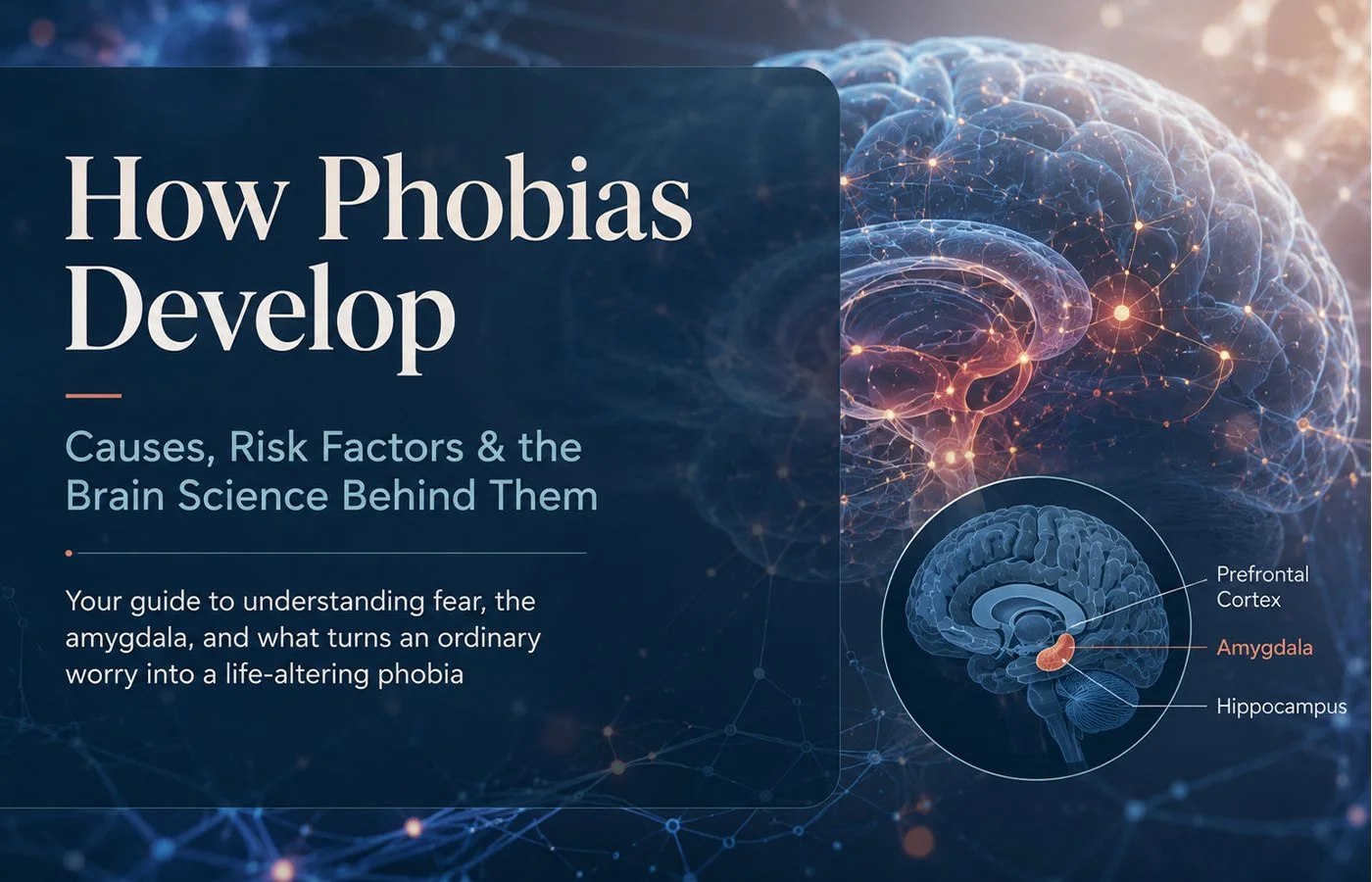
To understand how phobias form, you first need to understand how your brain processes fear. And the main character in that story is a small, almond-shaped structure sitting deep inside your brain called the amygdala.
The Amygdala: Your Brain's Built-In Alarm System
The amygdala is your emotional threat-detection center. It has been doing this job for millions of years of human evolution. Before we had language or logic, we needed something that could detect danger fast and trigger a response even faster.
When your amygdala senses a potential threat, whether that threat is real or perceived, it fires off an alarm signal in milliseconds. This triggers your body's fight-or-flight response:
• Heart rate surges
• Muscles tense and prepare for action
• Breathing becomes rapid and shallow
• Digestion slows down
• Pupils dilate to sharpen vision
• Adrenaline and cortisol flood the bloodstream
All of this happens before your thinking brain, the prefrontal cortex, even gets a chance to evaluate whether the threat is real. The amygdala moves fast. Logic moves slow.
The Prefrontal Cortex: The Rational Voice That Arrives Late
Your prefrontal cortex is the part of your brain responsible for rational thought, decision-making, and emotional regulation. It can override the amygdala's alarm signal, but only if it gets enough time and space to do so.
In people with phobias, research suggests that the amygdala becomes hypersensitive to specific triggers. It fires more strongly and more quickly than it should, and the prefrontal cortex struggles to calm it down. The rational part of the brain knows the spider is not going to kill anyone. But the alarm is already blaring, and the body is already running.
Memory, Fear, and Conditioned Responses
Another key player in phobia development is the hippocampus, which is responsible for memory formation. When a frightening experience happens, the hippocampus works alongside the amygdala to stamp that experience deep into emotional memory.
This is why a single terrifying event, like being stung by a wasp as a child, can create a fear response that lasts for decades. The brain essentially tags wasps as dangerous and stores that label in long-term emotional memory. Every time wasps appear again, the amygdala retrieves that memory and fires the alarm almost automatically.
This is known as fear conditioning, and it is one of the foundational mechanisms behind how phobias develop.
Why Do Some People Develop Phobias While Others Do Not?
This is one of the most fascinating and important questions in phobia research. Two siblings grow up in the same house, both encounter the same aggressive dog as children. One develops a lifelong dog phobia. The other is cuddling with golden retrievers by age twelve.
The answer lies in a combination of biological, psychological, and environmental factors that interact differently in each person.
1. Direct Traumatic Experiences
The most straightforward cause of a phobia is a direct, frightening encounter with the thing being feared. This is called direct conditioning.
• A child who nearly drowns may develop aquaphobia (fear of water)
• A person involved in a car accident may develop vehophobia (fear of driving)
• Someone who experienced a frightening medical procedure may develop a blood or needle phobia
However, not every traumatic encounter leads to a phobia. Other factors must also be in play, which brings us to the next causes.
2. Childhood Experiences and Developmental Vulnerability
The brain is at its most impressionable during childhood. The neural pathways that shape emotional responses are still being formed, which means scary experiences during these years can have an outsized and lasting impact.
Children who experienced:
• Chronic stress or neglect
• Overprotective parenting that modeled the world as dangerous
• Repeated exposure to frightening situations without a sense of safety or control
• Bullying, abuse, or emotional trauma
...are at a significantly higher risk of developing phobias and other anxiety disorders later in life.
Interestingly, not all childhood phobias stick around. Many children naturally outgrow fears of monsters, the dark, or loud noises. But when a childhood fear is intensely reinforced and never properly processed, it can take root and grow into adulthood.
3. Vicarious Learning: Watching Others Be Afraid
You do not always have to experience something scary yourself to develop a phobia of it. Sometimes, simply watching someone else react with intense fear is enough to teach your brain that a particular thing is dangerous.
Researchers call this observational learning or vicarious conditioning.
A classic example: a child who watches their parent scream and climb on a chair every time they see a mouse is learning a fear response without ever having been harmed by a mouse. The parent's behavior communicates to the child's developing brain, that thing is a threat.
This is one reason phobias can appear to run in families even in the absence of shared genetics.
4. Information-Based Fear Learning
Phobias can also develop through information alone. If a child is repeatedly told that strangers are dangerous, that dogs will bite, or that flying is terrifying, the brain can build a fear association without any direct experience.
This is increasingly relevant in the age of social media, where graphic news coverage, viral fear-inducing videos, and health-related anxieties can plant seeds of phobic thinking, particularly in young people and individuals who already have anxiety sensitivity.
5. Genetics and Family History
There is a meaningful genetic component to phobias. Research shows that first-degree relatives of people with specific phobias are roughly three times more likely to have a phobia themselves compared to the general population.
But genetics rarely act alone. What seems to be inherited is not usually a phobia itself but rather:
• A heightened sensitivity to anxiety and stress
• A more reactive amygdala
• A tendency toward behavioral inhibition (being naturally more cautious and easily startled)
These traits create a biological foundation that, combined with environmental triggers, makes phobia development more likely.
6. Temperament and Personality Traits
Certain personality characteristics appear to make someone more vulnerable to developing phobias:
• Behavioral inhibition in childhood: shy, easily startled, cautious by nature
• High neuroticism: a tendency to experience negative emotions more intensely
• Anxiety sensitivity: a fear of anxiety symptoms themselves (misinterpreting a racing heart as a sign of danger)
• Low distress tolerance: difficulty sitting with uncomfortable feelings
Importantly, these are not character flaws. They are simply ways some nervous systems are wired, often shaped by both genetics and early life experience.
7. Existing Anxiety Disorders and Mental Health Conditions
Having one anxiety disorder significantly increases the risk of developing others, including phobias. Conditions frequently linked to phobia development include:
• Generalized Anxiety Disorder (GAD)
• Panic Disorder, especially when panic attacks become associated with specific places or situations
• PTSD, where trauma memories can become linked to specific triggers
• OCD, where fear becomes attached to particular thoughts or objects
This overlapping nature of anxiety disorders is why comprehensive mental health treatment that addresses the whole person tends to be more effective than narrowly targeting a single symptom.
8. Panic Attacks and the Birth of Agoraphobia
Panic attacks deserve special attention in the story of phobia development. A panic attack is a sudden surge of overwhelming fear and physical symptoms, including chest tightness, shortness of breath, dizziness, and a sense of unreality or impending doom.
When a panic attack happens in a specific location or situation, the brain can create a strong fear association with that place. A person who has a panic attack in a grocery store may begin to fear grocery stores. As they avoid more and more places where they fear having another attack, they gradually develop agoraphobia.
This cycle of panic, avoidance, and expanding fear is one of the most common and most disabling ways phobias grow over time.
How Avoidance Quietly Becomes the Problem Itself
Here is something that surprises many people when they first hear it: avoiding the thing you fear is the single most powerful force that keeps a phobia alive.
It makes perfect sense on the surface. If you are terrified of elevators, taking the stairs feels like a smart and painless solution. The moment you step onto that staircase instead, the anxiety melts away. Immediate relief. Your brain notices this and files it under effective coping.
But here is what is happening underneath:
• Every time you avoid the feared trigger, you deprive your brain of the opportunity to learn that the threat is not as dangerous as predicted
• The relief from avoidance reinforces the belief that the avoided thing truly was dangerous
• Over time, the phobia grows stronger because it has never been tested or challenged
• The zone of avoidance often expands outward, so you start avoiding more and more related situations
A person who avoids elevators may eventually avoid any building taller than two stories. Then any city with tall buildings. Then certain social events. A small avoidance can quietly hollow out a life.
The Real-Life Impact of Living with a Phobia
Phobias are far more than a quirky fear of spiders or heights. For many people, they represent a quiet but relentless limitation on the fullness of life.
Emotional Impact
• Chronic anxiety and dread before anticipated encounters with triggers
• Shame, embarrassment, and self-judgment for having a fear others may not understand
• Depression, particularly when phobias restrict social connection or career opportunities
• Low self-esteem and a sense of being 'broken' or 'weak'
• Social isolation as life is organized around avoidance
Physical Impact
• Racing heart and chest tightness
• Sweating, trembling, or shaking
• Nausea or stomach upset
• Dizziness or feeling faint
• Shortness of breath
• Headaches and muscle tension from chronic anxiety
Impact on Daily Life
• Avoiding medical care because of blood, needle, or hospital phobias, leading to real health consequences
• Missing career opportunities due to fear of travel, public speaking, or social situations
• Strained relationships when loved ones do not understand or feel limited by the phobia
• Financial impact from turning down jobs or opportunities
• Reduced quality of life as the world gradually shrinks
None of this is melodrama. These are real, documented consequences that make phobias a serious mental health issue deserving of compassionate, professional attention.
There Is a Way Out: Effective Treatments and Recovery for Phobias
Here is the most important thing to understand about phobias: they are among the most treatable of all mental health conditions. With the right support and approach, most people experience significant improvement, and many achieve complete resolution of their phobia.
Recovery is not about becoming fearless. It is about teaching your brain to respond to the trigger differently, so that fear no longer controls your choices.
1. Cognitive Behavioral Therapy (CBT)
CBT is the gold-standard first-line treatment for phobias, supported by decades of research. It works on two interconnected levels:
• Cognitive: Identifying and challenging the distorted thoughts and beliefs that feed the phobia. For example, examining the evidence for and against the belief that 'all dogs are dangerous' or 'I will definitely have a panic attack on the plane.'
• Behavioral: Changing the avoidance behaviors that keep the phobia entrenched, gradually replacing them with approach behaviors
A trained therapist will work with you to understand the thought patterns beneath your fear and gently but systematically dismantle them.
2. Exposure Therapy: The Most Powerful Tool in Phobia Treatment
Exposure therapy is considered the most effective single treatment for specific phobias. The premise is straightforward but requires skill to implement well: gradually and safely expose yourself to the feared trigger in a controlled environment until the anxiety response diminishes.
This process, called habituation, works because the brain learns through experience. When you face the feared trigger repeatedly and nothing terrible happens, the amygdala slowly updates its threat assessment. It stops sounding the full alarm.
Exposure can be done in several ways:
• In vivo exposure: Real-life, direct exposure to the feared object or situation, starting very small and building up gradually
• Imaginal exposure: Vividly imagining the feared situation in a safe therapeutic setting, useful when real exposure is impractical
• Virtual Reality Exposure Therapy (VRET): Using VR technology to simulate feared situations in a controlled, repeatable way. Increasingly common for flight phobias, heights, and social situations
Exposure is always done at your pace, with your consent, and with a trained professional guiding the process. It is not about being thrown in at the deep end.
3. Relaxation and Breathing Techniques
Learning to manage the physical symptoms of anxiety gives you tools to tolerate exposure and reduce day-to-day distress. Useful techniques include:
• Diaphragmatic breathing: Slow, belly-deep breathing that activates the parasympathetic nervous system and signals safety to the brain
• Progressive muscle relaxation: Systematically tensing and releasing muscle groups to reduce physical tension
• Mindfulness-based techniques: Observing fear without reacting to it, creating space between the trigger and your response
4. Acceptance and Commitment Therapy (ACT)
ACT takes a slightly different approach than traditional CBT. Rather than directly challenging fearful thoughts, ACT teaches you to accept the presence of fear without letting it dictate your behavior. The goal is values-based living, doing what matters to you even in the presence of fear rather than waiting until fear disappears.
For many people, particularly those who have struggled with CBT's thought-challenging approach, ACT offers a gentler and equally effective path.
5. Medication
Medication is not typically a first-line treatment for specific phobias on its own, but it can be a helpful support, particularly when phobias co-occur with panic disorder, generalized anxiety, or depression. Options a psychiatrist might discuss include:
• Beta-blockers: Sometimes used situationally to manage physical symptoms like rapid heart rate before an anticipated trigger (such as a flight)
• Selective Serotonin Reuptake Inhibitors (SSRIs): Often used when phobias occur alongside broader anxiety disorders
• Benzodiazepines: Occasionally used short-term for acute anxiety, though not recommended for long-term phobia management due to dependency risk
Medication decisions should always involve a conversation with a qualified psychiatrist who can evaluate your full clinical picture.
6. Lifestyle Support That Makes Therapy Work Better
Recovery from phobias does not happen only in the therapy room. Lifestyle factors play a meaningful supporting role:
• Regular exercise: Proven to reduce baseline anxiety and increase stress resilience
• Quality sleep: Anxiety symptoms are significantly worsened by poor sleep, and sleep is critical for memory consolidation and emotional regulation
• Caffeine and alcohol moderation: Both can worsen anxiety symptoms, with alcohol in particular disrupting healthy fear processing
• Social support: Talking openly with trusted people about your phobia reduces shame and increases accountability for treatment
• Stress management: High stress raises baseline anxiety, which makes phobia triggers hit harder
7. When to Seek Professional Help
It is time to reach out to a mental health professional when:
• Your phobia is causing you to avoid situations that matter to your life, work, or relationships
• Anticipatory anxiety about a trigger is affecting your day-to-day wellbeing
• You are organizing significant life choices around the phobia
• You have tried to address it on your own without success
• The fear is accompanied by panic attacks, depression, or other anxiety symptoms
You Are Not Defined by Your Fear
Phobias are not a personal failing. They are not evidence of weakness, irrationality, or a broken mind. They are the result of a very intelligent, very ancient survival system that has, through a combination of biology, experience, and circumstance, become calibrated a little too sensitively.
The brain that learned to fear also has an extraordinary capacity to unlearn. With the right support, the right approach, and the courage to take one small step toward what scares you, change is genuinely possible.
Every person who has ever sat in a therapist's office and said, 'I know it sounds ridiculous, but I am terrified of...' deserves to be heard, not dismissed. And every person who has ever had their world quietly shrunk by a phobia deserves to know that the world can be made bigger again.
If what you have read today resonates with your own experience, or with someone you love, please know that help is available, that recovery is real, and that the first conversation is always the hardest and most important one.
You do not have to live smaller than you want to. Reach out to a qualified mental health professional and begin your path back to a fuller life.
Knowing what phobia is matters. But knowing it is treatable matters even more.
Phobias rarely resolve on their own. The longer avoidance continues, the more deeply rooted the fear becomes. Taking action earlier, even when it feels uncomfortable, gives you the best possible chance at lasting change.
At Evolve Psychiatry, our team of psychiatrists, therapists, and nurse practitioners provides evidence-based phobia treatment that is tailored to your specific experience. We do not use a one-size-fits-all approach. We take the time to understand what you are going through, what triggers your fear, and what your life looks like, so we can build a plan that fits you.
Evolve Psychiatry offers in-person care at six clinics across New York and North Carolina:
• Evolve Psychiatry, Massapequa, New York
• Evolve Psychiatry, Syosset, New York
• Evolve Psychiatry, Albany, New York
• Evolve Psychiatry, Garden City, New York
• Evolve Psychiatry, Hauppauge, New York
• Evolve Psychiatry, Wilmington, North Carolina
Frequently Asked Questions About Phobias
Q1: What is the most common phobia in the United States?
Specific phobias are the most common anxiety disorder in the US. Among specific phobias, fears of animals (especially spiders and snakes), heights, blood/needles, and flying are among the most frequently reported. Social phobia is also extremely common, affecting millions of adults.
Q2: Can a phobia develop suddenly in adulthood with no apparent cause?
Yes, phobias can emerge in adulthood without a clearly identifiable single cause. Adult-onset phobias are often linked to a traumatic or distressing experience, a period of high stress that lowered the nervous system's threshold, or the cumulative effect of repeated anxious encounters with a particular trigger. Sometimes the original triggering event happened in childhood and was not consciously recognized as significant at the time.
Q3: Are phobias genetic? Can they run in families?
There is a genetic component to phobias, but genes do not determine destiny. What tends to be inherited is a predisposition toward anxiety sensitivity and a more reactive fear response, not a specific phobia itself. Environmental learning, particularly observing fearful behavior in caregivers, also plays a significant role in why phobias can appear across generations in the same family.
Q4: Can children outgrow phobias without treatment?
Many childhood fears are developmentally normal and do fade naturally as the child matures and their brain develops stronger emotional regulation. However, when a childhood fear is particularly intense, significantly disrupts daily functioning, or persists beyond the developmental stage where it would typically resolve, professional support can be enormously helpful in preventing it from solidifying into a lifelong phobia.
Q5: How long does treatment for a phobia take?
This depends on the severity of the phobia and the presence of co-occurring conditions. Many specific phobias can show significant improvement in as few as 8 to 12 structured therapy sessions using exposure-based CBT. More complex cases involving multiple phobias, panic disorder, or trauma history may require a longer course of treatment. The important thing is that progress tends to be measurable and encouraging even from the early stages.
Q6: Is it possible to develop a phobia through social media or news?
Yes, this is increasingly recognized as a meaningful pathway to phobia development, particularly in children and adolescents and in individuals with pre-existing anxiety sensitivity. Repeated exposure to graphic, frightening, or health-related content online can create or reinforce fear associations. This is sometimes called information-based fear conditioning and represents an important area of awareness for parents and caregivers.
Q7: What is the difference between a phobia and general anxiety?
General anxiety involves a broad, often diffuse worry about multiple life areas without a specific, predictable trigger. A phobia, by contrast, involves an intense fear response that is reliably activated by a specific object, situation, or activity. Many people experience both, and the two conditions can reinforce each other, which is why comprehensive assessment by a mental health professional is so important.
