
What Are the Mental Health Benefits of Doll Play for Children?
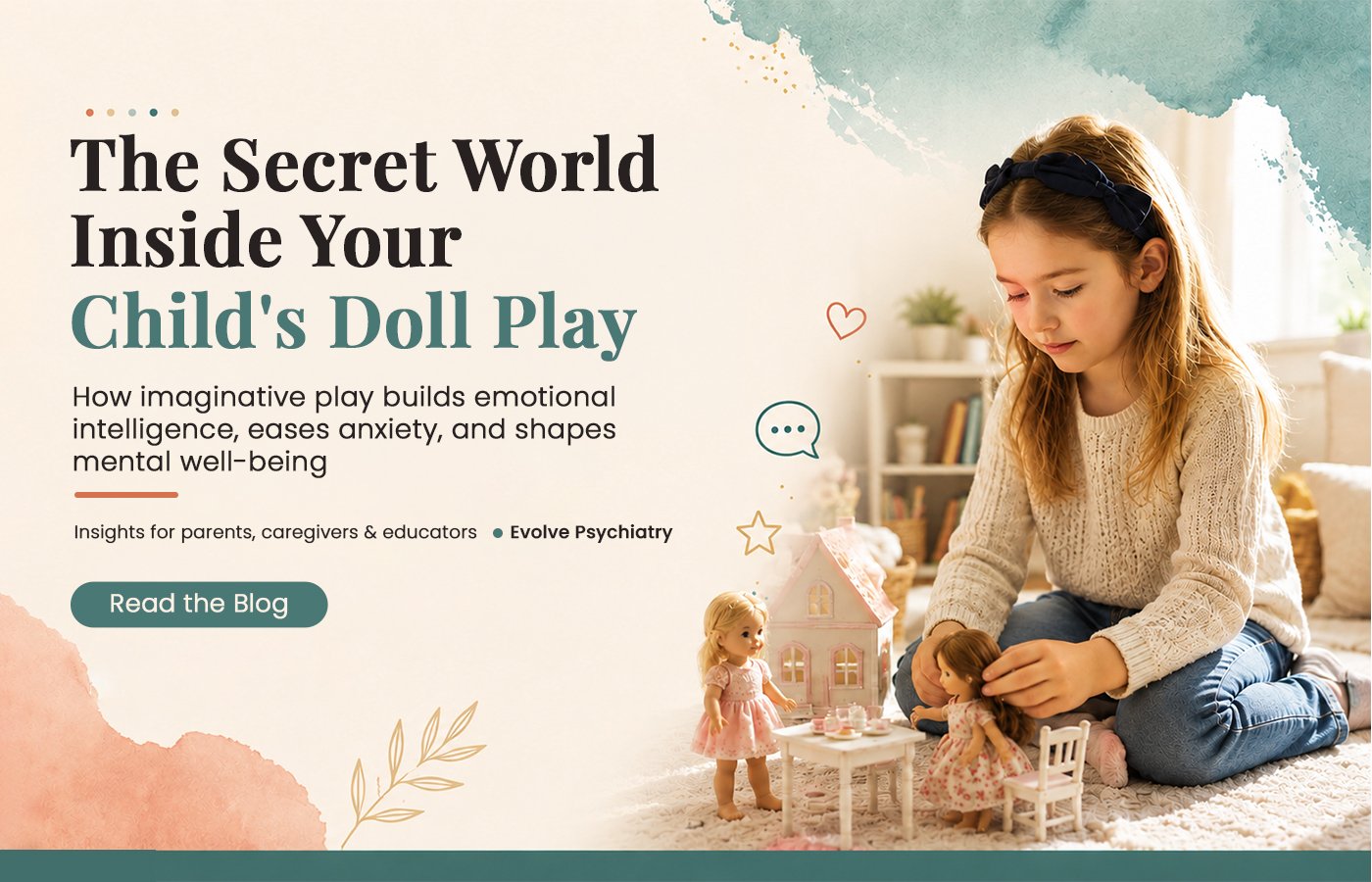
The Little Toy That Teaches Big Lessons
Think back to the last time you watched a child play with a doll.
Maybe they were rocking it gently, feeding it pretend food, or scolding it for being naughty. On the surface, it looks like simple fun. But what is really happening inside that child's mind is far more powerful than it appears.
Doll play is one of the oldest forms of childhood play. And today, child psychologists and mental health professionals recognize it as a deeply meaningful tool for emotional growth.
It helps children express feelings they cannot yet put into words. It teaches empathy, builds confidence, and even helps anxious or sensitive children feel safer in a big, sometimes overwhelming world.
In this blog, we explore the real mental health benefits of doll play for children. Whether you are a parent, a caregiver, or an educator, you will find practical insights and simple tips to make the most of this wonderful form of play.
“At Evolve Psychiatry, our child mental health specialists often see the power of play firsthand. Imaginative play, including doll play, is one of the most natural ways children begin to understand their emotions and the world around them.”
1. Emotional Expression Through Pretend Play
Young children often struggle to say exactly how they feel. The words are not there yet. But feelings are.
Doll play gives children a safe way to act out those feelings without even realizing they are doing it. A child who is feeling left out at school may pretend their doll is being excluded from a birthday party. A child who is nervous about a new sibling may act out scenes of jealousy with their dolls.
This kind of emotional expression through play is completely normal and healthy. It is the child's mind finding a way to process what is happening inside.
Why This Matters for Parents
When you watch your child play, you are getting a window into their inner world. The themes that show up in doll play can often tell you more about your child's emotional state than any direct conversation.
“Seven-year-old Maya started playing out arguments between her dolls every evening after her parents went through a separation. Her play was her way of processing a confusing emotional experience. A therapist at Evolve Psychiatry helped her parents understand that this was a healthy coping response.”
2. How Doll Play Helps Children Process Difficult Feelings
Children do not have the emotional vocabulary that adults do. But their brains are always working to make sense of their experiences.
Play therapists have long known that when children use dolls to replay upsetting events, they are actually doing emotional processing. The child is replaying the experience from a safe distance, with some control over the outcome.
This is very similar to how adults might journal about a bad day or talk things through with a friend. For children, the doll becomes that trusted outlet.
Feelings That Doll Play Helps Children Process
• Fear and worry about new situations (school, doctors, moving)
• Sadness after a loss, like a grandparent passing away or a pet dying
• Anger and frustration that children struggle to express verbally
• Confusion around big life changes like divorce or a new baby
• Loneliness and the desire for connection and friendship
When children have a safe emotional outlet, they are far less likely to bottle up feelings that could later surface as behavioral issues or anxiety.
3. Doll Play and Anxiety or Stress Reduction
Anxiety in children is more common than many parents realize. Some children worry about school. Others feel overwhelmed by social situations. Some carry anxiety that they cannot even explain.
Doll play can act as a gentle, natural stress reliever.
When a child plays freely with dolls, their body and brain relax. The repetitive, soothing nature of pretend play activates the parasympathetic nervous system. This is the part of the nervous system responsible for calm and rest.
Research in child psychology supports the idea that imaginative play lowers cortisol levels in children. Cortisol is the body's primary stress hormone.
Signs Doll Play Is Helping an Anxious Child
• The child seems calmer and more settled after play sessions
• They become more willing to talk about their worries afterward
• They sleep better after an evening of free play
• They are less reactive or emotional in general
“If your child seems anxious before a big event like surgery, a new school, or a move, try introducing doll play that mimics the scenario. Let your child act it out. This rehearsal through play can significantly reduce anticipatory anxiety.”
4. Role-Playing and Social Skill Development
When children play with dolls, they are almost always role-playing social situations. They create conversations. They act out disagreements and resolutions. They practice sharing, helping, and cooperating.
These pretend social interactions are actually rehearsals for real-life social skills.
A child who regularly plays out scenes where dolls share toys is practicing the concept of generosity. A child who plays out a conflict and then has dolls make up is learning basic conflict resolution.
Social Skills Practiced Through Doll Play
• Taking turns and sharing
• Understanding cause and effect in relationships
• Learning to comfort others (nurturing behavior)
• Practicing apologizing and forgiveness
• Navigating leadership and cooperation within imaginary groups
These are not small things. These are the building blocks of healthy relationships in school, friendships, and eventually the workplace.
5. Building Empathy and Emotional Intelligence
Empathy is the ability to understand and share the feelings of another person. It is one of the most important social-emotional skills a child can develop.
Doll play is a surprisingly powerful empathy builder.
When a child gives their doll a name, a story, and feelings, they are practicing perspective-taking. They are imagining what it would be like to be someone else. This mental exercise directly trains the brain's capacity for empathy.
Psychologists have found that children who engage in regular pretend play with dolls and figures tend to show higher levels of emotional intelligence than those who do not.
How to Encourage Empathy Through Doll Play
• Ask your child questions about the doll's feelings during play: "Why is she sad? What could we do to help her?"
• Introduce dolls that represent different backgrounds and life experiences
• Let your child take the lead without scripting their play
• After play, gently connect the doll's feelings to real-life situations
6. Doll Play and Confidence Building
Every time a child directs a scene, makes decisions for their doll, and solves problems in a pretend world, they are practicing confidence.
In the world of doll play, the child is in complete control. They decide who speaks, what happens next, and how problems get solved. This sense of agency, the feeling that "I can make things happen," is foundational to healthy self-esteem.
For children who feel powerless in the real world, perhaps because of an illness, a difficult family situation, or social struggles at school, this controlled creative play environment can be genuinely therapeutic.
How Confidence Builds During Doll Play
• The child practices decision-making in a low-stakes setting
• They experience creative achievement when they invent a story or solve a problem
• They build a sense of identity through the characters and values they project onto their dolls
• They feel proud of their imaginative worlds, which reinforces a positive self-image
7. Cognitive and Communication Benefits
Doll play is not just emotionally beneficial. It also provides meaningful cognitive development.
When children narrate their doll play, they are practicing language and storytelling. They build vocabulary as they describe scenes, emotions, and actions. They also develop sequencing skills as they think about what happens first, next, and last in a story.
Research has shown that children who engage in rich imaginative play demonstrate stronger narrative skills when they start school. These skills are directly linked to reading comprehension and academic success.
Cognitive Skills Strengthened by Doll Play
• Language development and vocabulary expansion
• Storytelling and narrative thinking
• Creative problem-solving
• Abstract thinking (imagining what is not physically present)
• Planning and sequencing
All of this happens naturally when a child is simply lost in play. There is no pressure, no grades, no right or wrong answer. Just a growing brain learning while it plays.
8. Doll Play and Children with ADHD or Emotional Challenges
Children with ADHD, anxiety, autism spectrum disorder, or other emotional challenges can benefit enormously from structured and semi-structured doll play.
For children with ADHD, playing with dolls and creating stories can actually improve focus and attention. When a child is deeply engaged in imaginative play they have chosen, their ability to concentrate increases significantly. This is sometimes called hyperfocus, and it is one of the strengths many children with ADHD naturally possess.
For children who struggle with sensory processing or emotional regulation, the predictability and control of doll play provides a sense of safety that is hard to find in more chaotic environments.
Benefits Specifically for Children with ADHD or Emotional Challenges
• Provides a structured creative outlet that channels excess energy
• Teaches emotional regulation through acted-out scenarios
• Helps with social scripting, practicing social interactions in a low-pressure way
• Improves patience and turn-taking through play
• Builds self-regulation as the child manages the pace of the story
“If your child has ADHD, anxiety, or other emotional challenges, speak with a child psychiatrist or therapist about how play therapy might complement their treatment. Evolve Psychiatry offers specialist support across all six of our clinics in New York and North Carolina.”
9. The Importance of Imaginative Play in Modern Childhood
Children today live in a screen-saturated world. Tablets, smartphones, and streaming services compete for their attention every day.
Free, imaginative play, including doll play, is becoming increasingly rare. Yet child development specialists agree that it is more important than ever.
The American Academy of Pediatrics has highlighted that unstructured play is essential for the healthy development of children's social-emotional skills, creativity, and resilience. These are skills that no app can replicate.
When a child plays with a doll, they are doing something no algorithm can do for them. They are creating, imagining, feeling, and growing from the inside out.
Simple Ways to Protect Imaginative Play Time
• Set aside at least 30 minutes of screen-free play time daily
• Resist the urge to schedule every hour of your child's day
• Offer open-ended toys like dolls, art supplies, and blocks that require creativity
• Play alongside your child sometimes, following their lead
• Create a simple, dedicated play space at home that feels safe and calm
10. A Parent's Guide to Supporting Healthy Doll Play
Now that you understand why doll play matters, here is how you can support it well.
How to Encourage Healthy Doll Play
• Give your child unstructured time to play without direction or interruption
• Offer a variety of dolls that reflect different ages, backgrounds, and life situations
• Sit nearby sometimes so your child knows play is valued and safe
• Ask open, curious questions after play, not during: "That seemed like a busy day for your doll. What happened?"
• Praise creativity, not just the story outcome
What Type of Doll Play Is Most Beneficial?
Not all play is the same. The most mentally beneficial doll play tends to be:
• Child-led, not adult-directed
• Emotionally expressive, allowing for both happy and difficult themes
• Open-ended, with no fixed rules or required outcomes
• Social when possible, shared with a sibling, peer, or caring adult
Signs That Play May Reflect Emotional Struggles
Most doll play themes are healthy and normal. But sometimes, the content of a child's play can signal deeper emotional distress. Pay attention if you notice:
• Repetitive play that replays the same frightening or violent scene over and over
• The child becomes very distressed or upset during play and cannot calm down
• Play themes that involve extreme helplessness, self-harm, or graphic violence
• The child refuses to play at all, showing a sudden loss of interest in play
• A sharp change in play themes following a traumatic event or major life change
These signs do not mean something is seriously wrong. But they are worth noting and discussing with a professional.
When to Seek Professional Mental Health Support
Trust your instincts as a parent. If your child's play consistently worries you, or if your child is showing signs of anxiety, depression, social withdrawal, or behavioral difficulties beyond what play can address on its own, it may be time to reach out to a mental health professional.
A child psychiatrist or therapist can assess your child's emotional needs, provide a proper evaluation, and recommend the right level of support, which may include play therapy as part of a broader treatment approach.
“At Evolve Psychiatry, our child and adolescent mental health specialists work with families across Massapequa, Syosset, Albany, Garden City, Hauppauge, and Wilmington, NC. If you have concerns about your child’s emotional well-being, we welcome you to reach out. You do not have to figure it out alone.”
Let Them Play. It Is Serious Business.
The next time your child loses themselves in doll play, take a moment to appreciate what is really happening.
They are not just playing. They are learning to feel. They are practicing empathy. They are rehearsing courage. They are building the emotional foundations that will carry them through life.
As a parent, one of the most powerful things you can do for your child's mental health costs nothing and requires very little. Simply protect their right to play freely, imaginatively, and without pressure.
Give them time. Give them space. Give them a doll and step back.
And if you ever feel like your child needs more support than play alone can provide, know that help is available. Caring, compassionate professionals are just a phone call away.
Evolve Psychiatry offers in person care at six clinics across New York and North Carolina:
• Evolve Psychiatry, Massapequa, New York
• Evolve Psychiatry, Syosset, New York
• Evolve Psychiatry, Albany, New York
• Evolve Psychiatry, Garden City, New York
• Evolve Psychiatry, Hauppauge, New York
• Evolve Psychiatry, Wilmington, North Carolina
You do not have to keep managing this alone. Reach out to our team today and take the first step toward the mental health you deserve.
