
What Is Fear of Death? Understanding Thanatophobia and Finding Real Relief
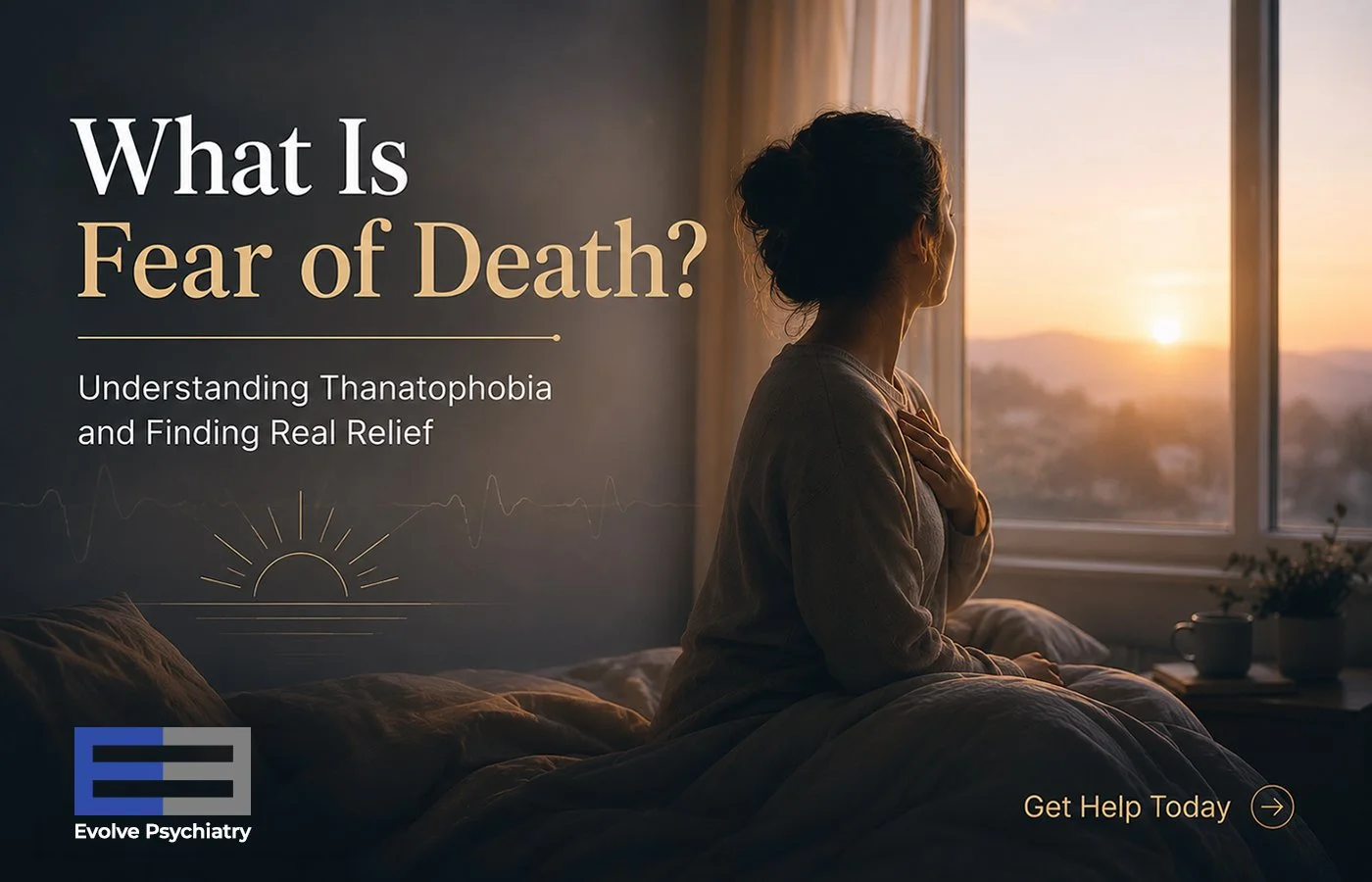
The good news is that this fear has a name, a clear explanation, and real, proven paths toward relief. You do not have to keep carrying it alone.
1. When Thoughts of Dying Won't Let You Rest
It is 2 a.m. and your mind will not stop. A random thought about dying slipped in an hour ago, and now your heart is racing, your palms are sweaty, and sleep feels impossible. If this sounds familiar, you are far from alone. So what is fear of death, really, and why does it sometimes feel so overwhelming?
For many people, this fear shows up quietly at first: a flicker of dread during a routine doctor's visit, a wave of panic after watching the news, a sleepless night after a loved one's diagnosis. For others, it grows into something that shapes daily decisions and steals peace of mind.
The good news is that this fear has a name, a clear explanation, and real, proven paths toward relief. You do not have to keep carrying it alone.
Table of Contents
1. When Thoughts of Dying Won't Let You Rest
2. What Is Fear of Death, Really?
2.1 Defining Fear of Death and Thanatophobia
2.2 Fear of Death vs. Normal Awareness of Mortality
2.3 How Common Is This Fear?
3. Why Do We Develop a Fear of Death?
3.1 Psychological Roots of Death Anxiety
3.2 Life Events and Triggers
3.3 The Role of Existential Anxiety
4. Recognizing the Symptoms of Thanatophobia
4.1 Emotional and Mental Symptoms
4.2 Physical Symptoms
4.3 When It Starts Interfering With Daily Life
5. You Are Not Alone: Finding Relief From Fear of Death
5.1 Evidence-Based Treatment Options
5.2 Practical Coping Strategies for Daily Life
5.3 How to Overcome Fear of Death With Professional Support
6. Frequently Asked Questions About Fear of Death
7. Take the First Step With Evolve Psychiatry
2. What Is Fear of Death, Really?
2.1 Defining Fear of Death and Thanatophobia
Fear of death is exactly what it sounds like: a persistent, distressing worry about dying or about death itself. When this fear becomes intense, frequent, or hard to control, it has a clinical name: thanatophobia.
Thanatophobia falls under a category called specific phobia, the same broad category that includes fears of heights, flying, or enclosed spaces. The difference is that thanatophobia centers on the idea of death, whether that is your own mortality, the death of someone you love, or the process of dying itself.
Having a clinical name does not mean something is wrong with you. It means your experience is recognized, understood, and treatable. Specific phobias are some of the most responsive conditions to therapy, which is genuinely good news for anyone living with this fear.
2.2 Fear of Death vs. Normal Awareness of Mortality
Almost everyone thinks about death sometimes. Watching a parent age, attending a funeral, or simply getting older can bring mortality into focus. That is a normal, healthy part of being human.
Thanatophobia is different. It is not a passing thought; it is a recurring, intrusive fear that triggers real physical and emotional distress. It can interrupt sleep, work, relationships, and routine activities like going to the doctor.
The key distinction is impact. If thinking about death occasionally crosses your mind and then fades, that is normal awareness. If it grips you, won't let go, and starts shaping your choices, that points toward something worth addressing with support.
2.3 How Common Is This Fear?
Fear of death is far more common than most conversations let on. It touches teenagers facing first losses, young adults navigating health scares, parents worried about leaving children behind, and older adults confronting their own aging.
Researchers have studied death anxiety across cultures and age groups for decades, consistently finding it among the most universal human fears. You are not an outlier for feeling this; you are part of a very large, very human group.
Talking about it openly is one of the simplest ways to reduce the isolation that often comes with this fear. The more it is named, the less power it tends to hold.
3. Why Do We Develop a Fear of Death?
3.1 Psychological Roots of Death Anxiety
Death anxiety often grows out of uncertainty. Death is, by definition, unknown, and the human mind tends to fill unknowns with worst-case scenarios. For some, this fear is tied to a deep need for control, and death represents the ultimate loss of it.
For others, death anxiety connects to unresolved grief. Losing someone without fully processing that loss can leave the mind circling around mortality long after the funeral ends.
Anxiety disorders more broadly can also amplify this fear. If you already live with generalized anxiety or panic disorder, your mind may be more prone to fixating on death as one of many catastrophic possibilities.
3.2 Life Events and Triggers
Certain life events tend to trigger or intensify fear of dying. A new health diagnosis, even a minor one, can set off a spiral of “what if” thinking. Losing a parent, spouse, or close friend often brings a sudden, sharp awareness of your own mortality.
Major transitions, like becoming a parent, turning a milestone age, or starting a serious illness treatment, can also stir up this fear. These moments tend to crack open the protective distance most people keep from thoughts of death.
Recognizing your specific triggers is a useful first step. It helps you and a treatment provider understand the shape of your fear, rather than treating it as one vague, overwhelming cloud.
3.3 The Role of Existential Anxiety
Fear of death often overlaps with something broader called existential anxiety: deeper worries about meaning, purpose, and what life adds up to. These questions are not signs of a problem on their own; they are part of being a thoughtful person.
But when existential anxiety becomes constant or paralyzing, it can fuel and intensify fear of death rather than simply coexisting with it. The two can feed each other in a loop that feels hard to escape alone.
Understanding this connection matters because effective treatment often addresses both layers: the immediate fear response and the deeper questions sitting underneath it.
4. Recognizing the Symptoms of Thanatophobia
4.1 Emotional and Mental Symptoms
Thanatophobia frequently shows up as persistent, intrusive thoughts about death that are hard to redirect. You might notice constant worry that arrives without an obvious trigger, or a sense of dread that spikes around reminders of mortality, like medical appointments, funerals, or news stories.
Some people describe a feeling of impending doom that seems to come from nowhere. Others notice their mind jumping straight to worst-case health scenarios over minor symptoms.
These mental symptoms are exhausting, not because you are overreacting, but because your nervous system is responding to a perceived threat as though it were immediate and real.
4.2 Physical Symptoms
Fear of death does not stay only in the mind; it shows up in the body too. A racing heart, tight chest, shortness of breath, sweating, and nausea are all common physical responses, especially at night when distractions fade and the mind quiets down.
Many people experience insomnia tied directly to this fear, lying awake as thoughts spiral. Some describe symptoms that closely mirror a panic attack: dizziness, trembling, or a sudden wave of physical alarm.
These physical symptoms are real and valid. They are your body's stress response activating, not a sign that something is fundamentally wrong with your health.
4.3 When It Starts Interfering With Daily Life
The clearest sign that fear of dying has crossed into thanatophobia is functional impact. This often looks like avoidance: skipping doctor's appointments out of fear of bad news, avoiding hospitals, or steering clear of conversations and media that mention death.
Social withdrawal can follow, as constant worry makes it harder to be present with family or friends. Work and daily routines may also suffer as intrusive thoughts pull focus away from everyday tasks.
If you recognize this pattern in yourself or someone you love, it is a meaningful signal, not a personal failing. It is also a clear sign that professional support could help.
5. You Are Not Alone: Finding Relief From Fear of Death
5.1 Evidence-Based Treatment Options
If you are living with thanatophobia, you are not alone, and real, evidence-based treatment exists. Cognitive behavioral therapy, often called CBT, is considered the leading treatment for specific phobias, including fear of death.
CBT works by helping you identify the thought patterns that fuel the fear and gradually rebuild a healthier relationship with those thoughts. In some cases, gentle exposure-based techniques are used to reduce the intensity of the fear response over time, always at a pace that feels manageable.
For people whose fear of death is tied to broader anxiety or depression, medication management may also play a supportive role alongside therapy, guided by a qualified provider.
5.2 Practical Coping Strategies for Daily Life
Alongside professional treatment, everyday strategies can ease the intensity of this fear. Grounding techniques, like naming five things you can see and hear in the room, help interrupt a spiral before it builds.
Mindfulness practices, even five minutes a day, train your mind to notice anxious thoughts without being swept away by them. Journaling can also help externalize racing thoughts, making them feel more manageable on paper than they do in your head.
It also helps to limit excessive health-symptom searching online, which tends to feed the fear rather than calm it. Small, consistent habits add up to real relief over time.
5.3 How to Overcome Fear of Death With Professional Support
Learning how to overcome fear of death is realistic, and you do not have to figure it out by yourself. Working with a knowledgeable therapist or psychiatrist gives you a structured, personalized path forward instead of guesswork.
Board-certified psychiatrists can help untangle whether your fear of death stands on its own or connects to an underlying condition like generalized anxiety or panic disorder, and build a treatment plan around what they find.
Recovery from thanatophobia does not mean never thinking about death again. It means thinking about it without it controlling your days, your sleep, or your sense of safety.
6. Frequently Asked Questions About Fear of Death
6.1 Is fear of death a real mental health condition?
Yes. When fear of death becomes persistent and distressing, it is recognized clinically as thanatophobia, a type of specific phobia. It is a legitimate, well-documented condition, and like other specific phobias, it responds well to treatment.
6.2 What causes thanatophobia?
Thanatophobia often develops from a mix of factors: unresolved grief, health scares, a need for control, or an existing anxiety disorder. Major life transitions can also trigger or intensify it. There is rarely one single cause.
6.3 How do I know if my fear of death is severe enough to need help?
Severity is less important than impact. If fear of dying disrupts your sleep, relationships, or daily routine, or causes you to avoid medical care, it is worth addressing, regardless of how it compares to anyone else's experience.
6.4 Can therapy really help with fear of dying?
Yes. Cognitive behavioral therapy is an evidence-based treatment specifically effective for phobias like thanatophobia. Many people see meaningful improvement within a structured course of therapy, often combined with practical coping strategies.
6.5 Is death anxiety the same as a panic disorder?
Not exactly, though they can overlap. Death anxiety centers specifically on dying or mortality, while panic disorder involves recurring panic attacks that may or may not be death-related. Both are treatable, and a provider can help clarify which fits your experience.
6.6 What is the first step to getting help for fear of death?
The first step is usually a psychiatric evaluation. A board-certified provider can assess what is driving your fear and recommend the right combination of therapy, coping tools, or medication management for your specific situation.
7. Take the First Step With Evolve Psychiatry
You do not have to manage fear of death alone, and reaching out is not a sign of weakness; it is a sign of strength. At Evolve Psychiatry, our board-certified psychiatrists provide compassionate, evidence-based care to help you understand your fear and build real, lasting relief.
Whether you are noticing the first signs of thanatophobia or have been carrying this fear for years, personalized support is closer than you think.
Evolve Psychiatry offers in-person care at six clinics across New York and North Carolina:
Reach out today and take the first step toward facing this fear with the right support beside you.
