
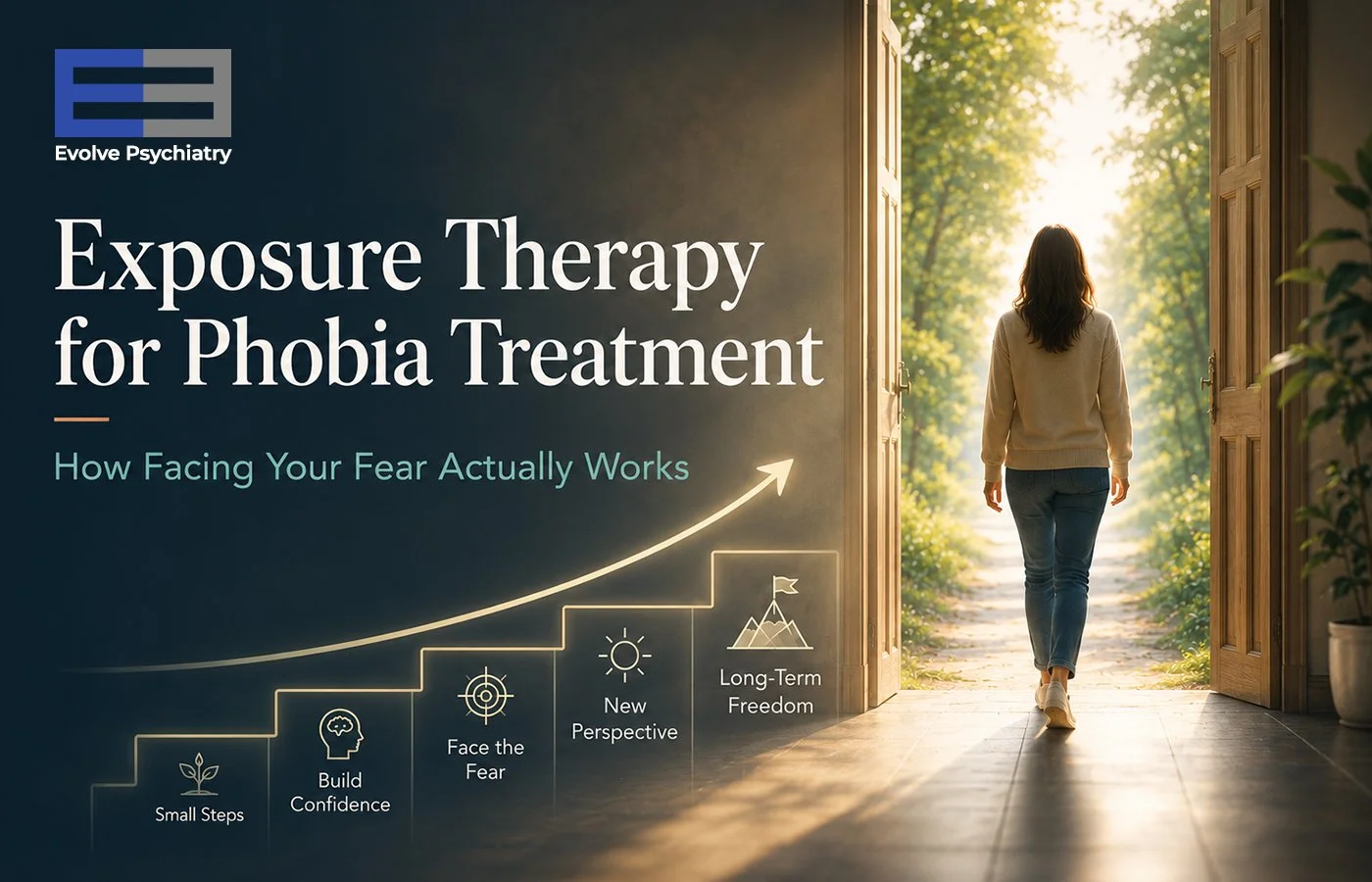
Exposure Therapy for Phobia Treatment: How Facing Your Fear Actually Works
The Thing Nobody Tells You About Living With a Phobia
Picture this: you decline an invitation to a friend's rooftop party. You take a 45-minute detour just to avoid driving over a bridge. You reschedule a doctor's appointment for the third time because the thought of a needle makes your stomach drop. From the outside, these choices might look like preferences. But for millions of people, they are quiet acts of survival.
A phobia does not just create fear. It quietly rearranges your life around that fear. And here is what makes it so frustrating: the more you avoid the thing you are afraid of, the more powerful that fear becomes. This is the part most people do not realize until they are deep inside it.
The good news is that phobia treatment works, and exposure therapy is one of the most proven approaches available. If the idea of "facing your fear" makes you want to close this tab, keep reading. The reality of how it works is far more manageable and far more hopeful than you might expect.
What Is a Phobia and How Is It Different From Ordinary Fear?
Fear is a normal and healthy response. When you see a car speeding toward you, fear tells your body to move. That reaction keeps you safe. A phobia is different. It is an intense, persistent, and irrational fear of a specific object, situation, or activity that poses little to no real danger.
Someone with a phobia knows, on a rational level, that a small spider or a crowded elevator is unlikely to seriously harm them. But the fear response kicks in anyway, and it is overwhelming. The body floods with adrenaline. The heart races. Breathing becomes shallow. The urge to escape is immediate and urgent.
Common phobias include a fear of heights, flying, animals, needles, blood, enclosed spaces, and social situations. But phobias can develop around almost anything. And no phobia is too minor or too unusual to deserve proper care and phobia treatment.
You Are Not Alone in This
Phobias are among the most common mental health conditions. They affect people across every age group, background, and walk of life. Having a phobia does not mean something is fundamentally wrong with you. It means your brain developed a fear response that is now misfiring in situations that do not actually require it. That is something that can be changed.
Why Phobias Get Stronger When You Avoid Them
Here is the trap that most people with phobias fall into without knowing it. When you encounter something frightening and you remove yourself from the situation, the fear instantly eases. That feeling of relief is powerful. Your brain registers it as a success: the threat was avoided, and you are safe.
But your brain also records a second lesson at the same time: the situation was genuinely dangerous, and escaping was the right move. This reinforces the fear. The next time you are near that trigger, the alarm sounds even louder. Avoidance does not quiet a phobia. It trains the brain to treat the fear as more justified and more serious over time.
Think of it like a smoke alarm that goes off every time you make toast. Each time you flee the kitchen rather than examining the alarm, the alarm becomes more sensitive to the smell of bread. You have not solved the problem. You have just made it easier for the alarm to fire.
The Slow Shrinking of Your World
Avoidance rarely stays contained to one situation. Someone who avoids dogs might stop visiting friends who have pets. Then they stop going to parks. Then they hesitate before walking down certain streets. The fear expands to cover more and more ground. Without effective phobia treatment, avoidance can quietly shrink the size of a person's life, sometimes without them fully noticing until a great deal has already been lost.
Common Misconceptions About Phobia Treatment That Hold People Back
Many people never seek phobia treatment because of what they believe the process involves. Most of those beliefs are inaccurate.
• "You just need willpower." Phobias are not a character flaw. They are learned fear responses rooted in how the brain processes threat. Willpower alone does not rewire the nervous system.
• "Therapy will throw me into my worst fear immediately." This is perhaps the most damaging myth. Exposure therapy is gradual and entirely paced by the person going through it. Nothing happens before you are ready.
• "Phobias go away on their own." For most people, they do not. Without treatment, phobias tend to persist and often worsen over time as avoidance builds.
• "Therapy takes years." For specific phobias, meaningful improvement is often achieved in a relatively short period of structured treatment.
• "Only people with severe anxiety need help." Any phobia that is affecting your quality of life, your choices, or your relationships is worth addressing. Waiting for things to get worse is not necessary.
What Is Exposure Therapy and Why Is It Used for Phobia Treatment?
Exposure therapy is a structured, evidence-based form of therapy that involves gradually and safely confronting the situations, objects, or thoughts that trigger fear. It is one of the most widely researched and clinically recommended approaches for phobia treatment, and it sits within the broader framework of cognitive behavioral therapy.
The key word in that definition is "gradually." Exposure therapy is not about forcing someone into a terrifying situation and waiting for the fear to subside. It is a carefully designed process, built collaboratively with a trained therapist, that moves at the person's own pace.
At its core, exposure therapy works on a simple but powerful idea: when you stay in contact with something you fear, without anything bad actually happening, your brain begins to revise its threat assessment. Slowly, the trigger loses its power.
Is Exposure Therapy the Right Phobia Treatment for Everyone?
Exposure therapy can be applied across a wide range of specific phobias, social anxiety, and other anxiety-related conditions. That said, every person's situation is different. A qualified mental health professional will assess the nature of the phobia, its severity, any related conditions, and what goals the person has before recommending a phobia treatment plan. In some cases, exposure therapy is combined with other approaches, including cognitive restructuring or medication, to support the process.
What Happens in Your Brain During Exposure Therapy
Understanding what is happening in your brain during exposure therapy can make the process feel less mysterious and more manageable. Two key processes explain why it works.
The first is called habituation. When you are exposed to a feared trigger repeatedly, and nothing harmful actually occurs, your nervous system begins to calm down in response to that trigger. The initial spike in anxiety gradually becomes smaller with each encounter.
The second is extinction learning. This is when the brain forms new associations with a previously feared trigger. Instead of the old memory that says "this is dangerous," the brain begins building a newer, stronger memory that says "this is safe." The old fear memory does not disappear entirely, but the new association competes with it and, over time, takes over as the dominant response.
The part of your brain most involved in this process is the amygdala, which acts as a threat-detection center. Exposure therapy essentially teaches the amygdala to stop misfiring in response to a situation that is not genuinely dangerous. The brain is not fixed. It is capable of learning new responses, and exposure therapy gives it the opportunity to do exactly that.
The Step-by-Step Process of Exposure Therapy for Phobia Treatment
Here is what the exposure therapy process typically looks like when someone seeks professional phobia treatment.
1. Assessment: Your therapist learns about the history of the phobia, what triggers it, how it affects your daily life, and what goals you want to work toward. This conversation is the foundation of your treatment plan.
2. Psychoeducation: Your therapist helps you understand how the fear-avoidance cycle works and why exposure is an effective way to break it. Understanding the rationale behind treatment increases confidence and commitment.
3. Building a Fear Hierarchy: Together, you and your therapist create a list of situations related to your phobia, ranked from least to most anxiety-provoking. This is often called a fear ladder.
4. Gradual Exposure: Starting at the bottom of the ladder, you begin confronting the situations on your list, one step at a time. You only move forward when you feel sufficiently comfortable at each level. The process is always in your control.
5. Review and Reinforcement: Throughout the process, your therapist helps you process each experience, celebrate progress, and work through any setbacks with compassion and practical support.
How Long Does Phobia Treatment Through Exposure Therapy Take?
Timelines vary depending on the person and the phobia involved. Specific phobias often respond well within a relatively focused course of treatment. Some people notice meaningful changes within a few weeks of consistent sessions. What matters most is not the speed but the steadiness of the process.
Real-Life Examples of Exposure Therapy in Action
Sometimes the best way to understand a process is to see it in action. Here are a few examples of how exposure therapy works in practice.
Fear of flying: A person might begin by simply looking at photographs of airplanes. The next step might be watching videos of flights. From there, they might visit an airport without boarding. Eventually, they work up to a short flight, with each step building confidence from the last.
Needle phobia: Someone might start by reading about injections in a calm, informational way. Then they might watch a video of a blood draw. Later, they sit in a medical room without receiving any procedure. Over time, they gradually work toward tolerating the actual experience.
Fear of public speaking: A person might begin by speaking in front of a mirror, then to one trusted friend, then to a small group, and eventually to larger audiences. Each step is a deliberate, supported move up the fear hierarchy.
In each of these cases, the person retains full agency throughout the phobia treatment process. Nothing is forced, and no step happens before the person feels genuinely ready to take it.
Types of Exposure Therapy Used in Phobia Treatment
Exposure therapy is not one-size-fits-all. Therapists use different formats depending on the nature of the phobia and what works best for the individual.
• In Vivo Exposure: Direct, real-world contact with the feared trigger. This is often the most effective form for specific phobias.
• Imaginal Exposure: The person vividly imagines the feared situation. This is useful when real-world exposure is not immediately practical or safe.
• Virtual Reality Exposure Therapy: Technology is used to simulate feared environments in a controlled, immersive way. This is increasingly used for phobias related to heights, flying, and public spaces.
• Interoceptive Exposure: This involves intentionally producing physical sensations, such as a racing heart, that are associated with fear. It is particularly useful when someone is afraid of the physical feelings of anxiety itself.
Does Exposure Therapy for Phobia Treatment Actually Work?
Exposure therapy is consistently recognized by mental health organizations as a first-line treatment for specific phobias and anxiety-related conditions. It is one of the most extensively studied approaches in clinical psychology, and the results across decades of research are strongly positive.
People who complete exposure therapy report not just reduced fear responses, but meaningful improvements in their quality of life. They describe being able to do things they had avoided for years, sometimes decades. Flying to see family. Visiting a doctor without dread. Riding an elevator. Attending social events.
The results are generally better when treatment is guided by a trained professional rather than attempted alone. A therapist understands the pacing, knows when to push gently and when to slow down, and provides the kind of support that makes it possible to sustain the process through the moments when it feels difficult.
"What If I Cannot Handle It?" Answering the Fears People Have Before Starting Treatment
It is completely understandable to feel nervous about starting phobia treatment. Here are some of the most common concerns people share, along with honest answers.
• "What if I have a panic attack?" Panic during exposure can happen, and a skilled therapist will help you manage it. Importantly, panic is uncomfortable but not dangerous, and working through it in a supported setting can actually accelerate progress.
• "What if it makes my phobia worse?" When conducted properly by a trained professional, exposure therapy does not make phobias worse. The gradual structure of the process is specifically designed to prevent overwhelming the person.
• "Will I be forced to do things I am not ready for?" No. A good therapist will never push you faster than you are ready to go. The entire process is built on collaboration and consent.
• "I have had this phobia for 20 years. Is it too late?" Absolutely not. Phobias that have been present for a long time can still respond well to treatment. The brain retains its capacity to learn new responses throughout life.
You Do Not Have to Keep Living Around Your Fear: How to Start Phobia Treatment
If anything in this article sounds familiar, the most important thing to know is this: recovery from a phobia is genuinely possible. You do not need to reach some threshold of suffering before you deserve help. If fear is limiting your choices, that is reason enough to seek support.
Starting phobia treatment begins with a single conversation. You reach out to a mental health professional, describe what you are experiencing, and let them guide you through an assessment. The first appointment is not an exposure session. It is just a conversation about your life and your goals.
From there, your treatment plan is built around you. If exposure therapy is recommended, it will be paced entirely to your comfort level. If medication could help manage anxiety during the process, that option can be discussed. If other therapeutic approaches would support your progress, they can be integrated. Phobia treatment is not a one-way track. It is a personalized path toward a life where fear does not get to make your decisions anymore.
Recovery is not about becoming fearless. It is about building the confidence and the tools to engage with your world fully, without the constant weight of avoidance. That is entirely within reach.
Find Compassionate Phobia Treatment at Evolve Psychiatry
At Evolve Psychiatry, our experienced psychiatrists, therapists, and nurse practitioners work with individuals dealing with phobias, anxiety disorders, and a wide range of mental health conditions. We take a personalized, evidence-based approach to phobia treatment, combining clinical expertise with genuine compassion for every person who walks through our doors.
Whether you have been living with a phobia for years or have recently noticed one beginning to affect your daily life, we are here to help you move forward.
Evolve Psychiatry offers in-person care at six clinics across New York and North Carolina:
• Evolve Psychiatry, Massapequa, New York
• Evolve Psychiatry, Syosset, New York
• Evolve Psychiatry, Albany, New York
• Evolve Psychiatry, Garden City, New York
• Evolve Psychiatry, Hauppauge, New York
• Evolve Psychiatry, Wilmington, North Carolina
Reaching out is the first and most important step. Our team is ready to support you.
Frequently Asked Questions About Phobia Treatment and Exposure Therapy
What is the most effective treatment for phobias?
Exposure therapy, particularly when delivered by a trained mental health professional, is widely considered the most effective approach for specific phobias. It is endorsed by leading psychiatric and psychological organizations as a first-line phobia treatment. In some cases, it is combined with medication or other therapeutic approaches for additional support.
Can exposure therapy make a phobia worse?
When conducted correctly by a qualified professional, exposure therapy does not make phobias worse. The gradual, controlled structure of the process is specifically designed to prevent overwhelming the person. Attempting exposure without professional guidance carries more risk, which is why working with a therapist is strongly recommended.
What is the difference between exposure therapy and flooding?
Flooding is a form of exposure therapy that involves intense, prolonged confrontation with the feared trigger from the beginning. Gradual exposure, by contrast, moves step by step up a fear hierarchy at the person's own pace. Most clinicians today use gradual approaches because they are better tolerated and equally effective for phobia treatment.
Can I do exposure therapy on my own at home?
Self-directed exposure is possible for mild fears, but for clinical phobias, professional guidance significantly improves outcomes. A therapist helps design the fear hierarchy, monitors progress, and provides the support needed to work through difficult moments without reinforcing avoidance. Without that guidance, it is easy to inadvertently practice the wrong type of exposure or stop too soon.
Is exposure therapy used for social anxiety and PTSD as well?
Yes. Exposure-based approaches are used for a range of anxiety-related conditions including social anxiety disorder and post-traumatic stress disorder. The specific format and structure of exposure will differ depending on the condition, but the underlying principle of safe, guided confrontation with feared experiences remains consistent.
How do I know if my fear is a phobia or just normal anxiety?
The key distinction is impairment. Normal fear is a proportionate response to a genuine threat that passes once the threat is gone. A phobia involves an intense, disproportionate, and persistent fear that causes significant distress and begins to interfere with daily functioning. If you are making regular decisions, avoiding places, or restricting your activities because of a fear, it is worth discussing with a professional.
What should I look for in a therapist for phobia treatment?
Look for someone with training and experience in cognitive behavioral therapy and exposure-based approaches. Ask whether they have worked with your specific type of phobia. A good therapist will explain their treatment approach clearly, answer your questions openly, and make you feel safe and respected throughout the phobia treatment process.
Fear Does Not Have to Be the One Calling the Shots Anymore
Living with a phobia is exhausting in ways that are hard to explain to someone who has not experienced it. It is not just the fear itself. It is the planning, the rerouting, the constant management of a world arranged around something you are trying to avoid. That kind of vigilance takes a real toll.
Exposure therapy works because it addresses the root of the problem rather than the symptoms. It does not just teach you to manage fear. It teaches your brain that the feared thing is not actually dangerous, and over time, that changes everything.
Phobia treatment is not about becoming someone who is never afraid. Fear is a part of being human. It is about making sure that fear is proportionate, accurate, and no longer running your life. That is a goal that is absolutely worth pursuing, and one that is genuinely within your reach.
If something in this article resonated with you, that is worth paying attention to. You do not have to figure this out alone. Reaching out to a mental health professional is not a last resort. It is a first step toward a more open, more connected, more fully lived life.
