
What is Fear of Failure? Understanding Atychiphobia and Why It May Be Holding You Back

When the Thought of Failing Stops You Before You Even Try
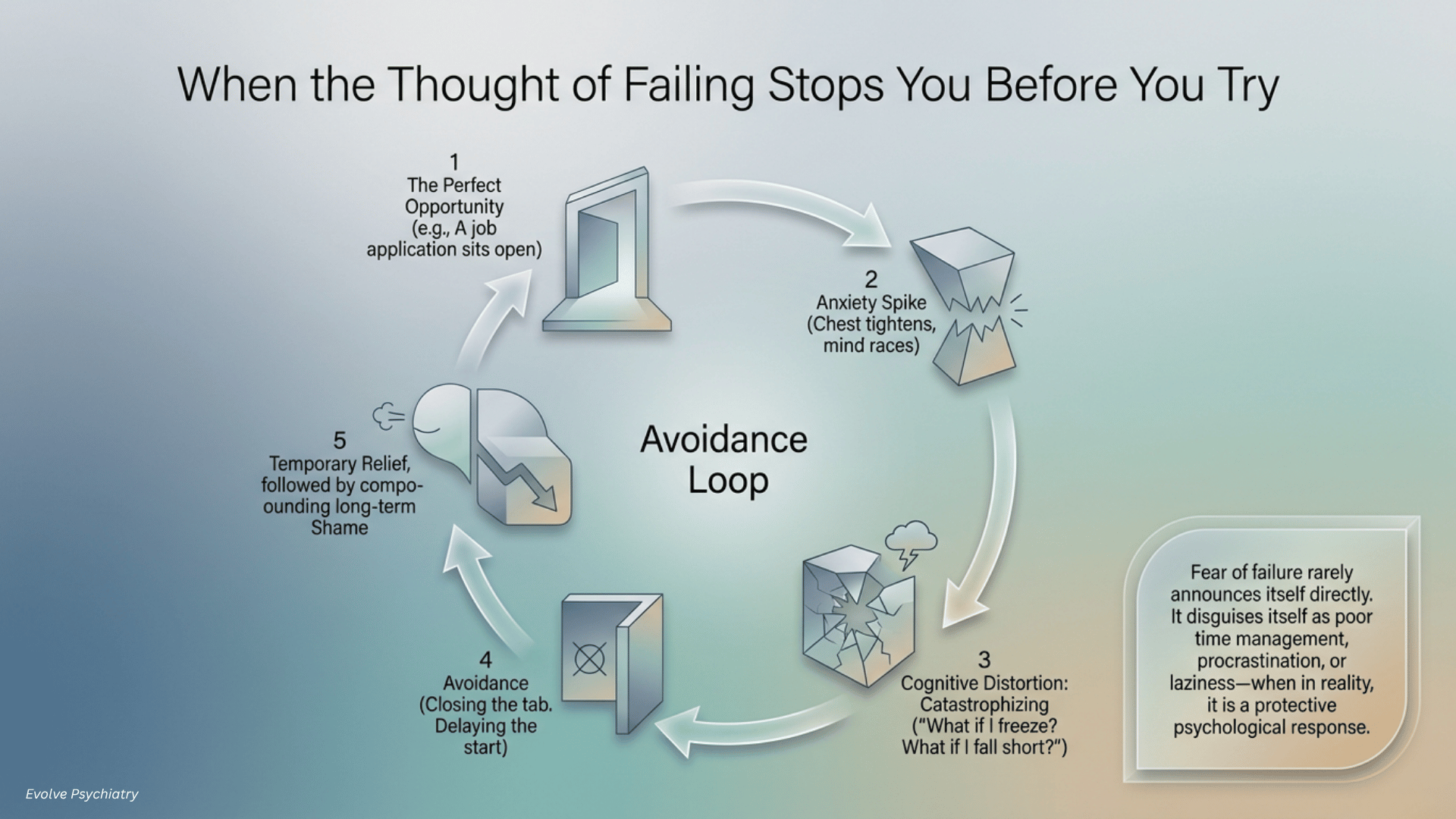
Imagine sitting in front of a job application you have been meaning to complete for weeks. The position is perfect for you. You have the skills, the experience, and the drive. But every time you open the form, something tightens in your chest. Your mind floods with worst-case scenarios. What if you apply and do not get it? What if you get the interview and freeze? What if you get the job and then fall short? So you close the tab. Again.
If this sounds familiar, you may already know what fear of failure feels like, even if you have never had a name for it. So what is fear of failure, exactly? It is more than just pre-game nerves or wanting to do well. For many people, it is a deep, persistent dread that quietly takes over decision-making, dims ambition, and chips away at self-worth.
This post will help you understand what fear of failure is, whether it can become a clinical condition known as atychiphobia, what causes it, and most importantly, what you can do about it.
What is Fear of Failure, Really?
When the Thought of Failing Stops You Before You Even Try
The Everyday Definition of Fear of Failure
At its core, fear of failure is a persistent and intense worry about what will happen if things do not go the way you hoped. It is not simply caring about outcomes or wanting to do your best. That kind of healthy motivation pushes people forward. Fear of failure, by contrast, stops people in their tracks.
When someone lives with fear of failure, the potential downside of trying feels so threatening that it outweighs any possible reward. The mind fixates on embarrassment, judgment, loss, or disappointment, often imagining consequences far worse than what would realistically happen. This fear is not occasional. It is a pattern. It shows up consistently across different areas of life and influences choices in ways that can feel automatic and hard to override.
Understanding what fear of failure is means recognizing it not as a character flaw but as a psychological response. It is something that develops over time, often for very understandable reasons, and it is something that can be treated.
How Fear of Failure Shows Up in Daily Life
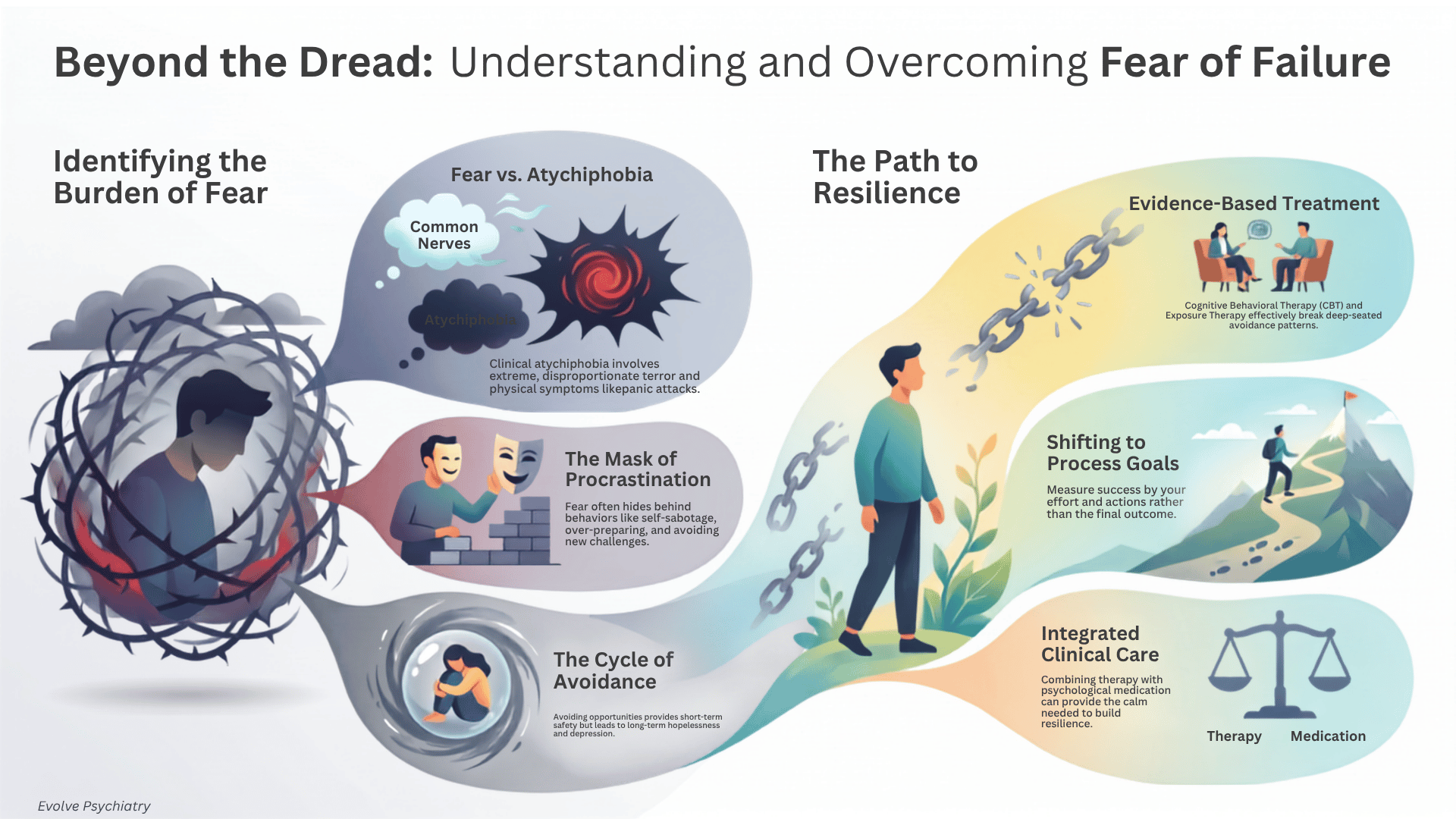
Fear of failure rarely announces itself directly. Instead, it disguises itself in behaviors that can look like laziness, indifference, or poor time management. Procrastination is one of the most common signs. When the idea of starting something feels tied to the threat of failing, it is easier to delay than to begin.
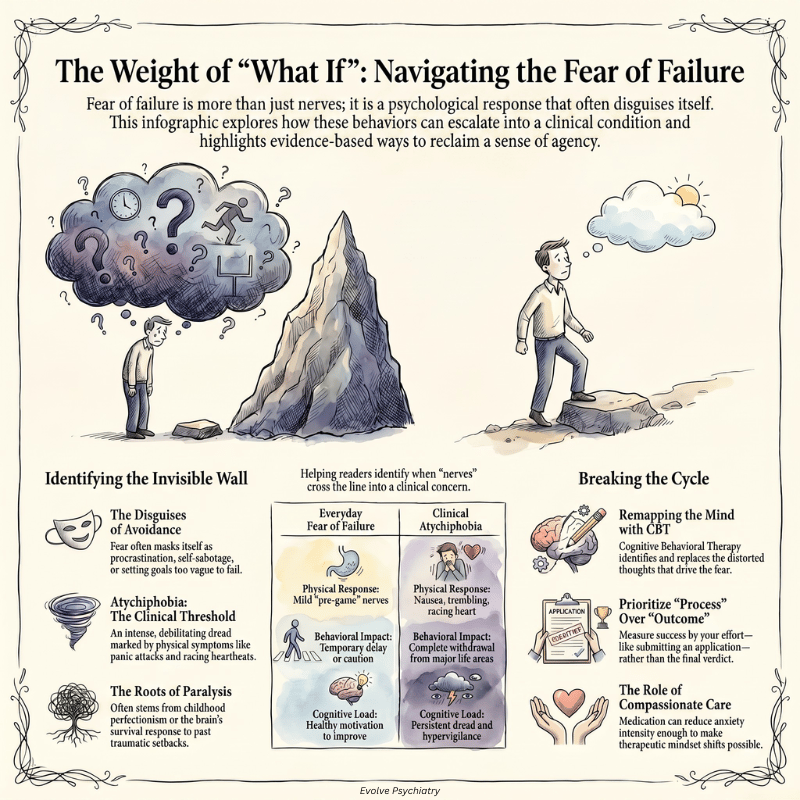
Other signs include self-sabotage (unconsciously undermining your own efforts so failure feels less personal), over-preparing without ever actually launching, setting vague goals that are impossible to truly fail at, or constantly making excuses to avoid new challenges. You might turn down promotions, avoid applying to programs, or skip social opportunities because the risk of things not working out feels unbearable.
These behaviors make sense as short-term protection strategies. But over time, they shrink your world. The things you want most stay just out of reach, not because you lack the ability, but because the fear of failure keeps pulling you back from the edge.
The Emotional Toll It Takes
Living with a persistent fear of failure is exhausting. On the surface, it might look like a lack of ambition. Internally, it often feels like a constant, low-grade hum of dread. There is shame tied up in it too, a sense that other people manage to try things and handle setbacks, so what is wrong with you?
Over time, the emotional weight compounds. Every avoided opportunity becomes evidence of inadequacy. Every decision not made becomes another confirmation of the fear. Self-worth starts to feel directly linked to outcomes, so avoiding outcomes becomes the only way to feel safe. This cycle, fear leading to avoidance, avoidance reinforcing the fear, can quietly escalate until the fear of failure begins to feel like the defining feature of your life.
Is Fear of Failure a Phobia? Understanding Atychiphobia
When Your Thoughts Stop You Before You Try
What Makes Something a Clinical Phobia
The word 'phobia' is used casually in everyday conversation, but clinically, it means something specific. A phobia is an intense, irrational fear of a specific object, situation, or outcome that is disproportionate to the actual threat it poses. People living with phobias do not just feel uncomfortable. They feel genuine terror, and they go to significant lengths to avoid whatever triggers that terror.
Phobias are classified as anxiety disorders in the DSM-5, the diagnostic manual used by mental health professionals. To meet the clinical threshold, the fear must cause significant distress, interfere with daily functioning, and persist over time. Phobias are not signs of weakness or irrationality on the part of the person living with them. They are recognized mental health conditions with effective treatments.
What separates a phobia from a strong dislike or a common fear is the intensity of the response and the degree to which it disrupts normal life.
Atychiphobia: When Fear of Failure Becomes a Phobia
Atychiphobia is the clinical term for an extreme, debilitating fear of failure. The word comes from the Greek 'atyches,' meaning unfortunate, and 'phobos,' meaning fear. While many people experience some degree of fear around failing, atychiphobia goes far beyond typical performance anxiety.
Someone living with atychiphobia may experience panic attacks when faced with situations where failure is possible. Physical symptoms can include a racing heartbeat, shortness of breath, sweating, nausea, dizziness, and trembling. The fear is not a background worry. It is overwhelming and feels completely out of proportion to the situation at hand.
Atychiphobia can cause a person to withdraw from major life areas entirely. Careers stall. Relationships are avoided. Education is abandoned. The fear of failure becomes so consuming that not trying feels like the only way to stay safe. When fear of failure reaches this level, it is no longer a mindset issue. It is a clinical condition that deserves professional attention.
How Do You Know If You Have Atychiphobia?
Because only a qualified mental health professional can provide a clinical diagnosis, the following questions are offered as a tool for self-reflection, not self-diagnosis. They may help you recognize whether what you are experiencing has moved beyond typical fear of failure.
Ask yourself: Does the fear of failing stop you from applying to jobs, pursuing relationships, or trying almost anything new? Do you experience physical symptoms, such as a racing heart or chest tightness, when facing situations where you might not succeed? Does the fear feel completely out of proportion to the actual stakes involved? Has avoiding failure become a primary way you make decisions, at the expense of the life you want to be living?
If several of these resonate strongly, it may be worth speaking with a mental health professional. Atychiphobia is treatable, and an accurate understanding of what you are living with is always the first step.
What Causes Fear of Failure? The Roots Behind the Pattern
Childhood Experiences and Perfectionism
Fear of failure rarely appears out of nowhere. For many people, its roots go back to early childhood. Growing up in an environment where love or approval felt conditional on performance can teach a child that their worth is tied to results. Highly critical parents, caregivers with very high standards, or environments where mistakes were met with punishment, ridicule, or withdrawal of affection can all plant the seeds of fear of failure early.
Perfectionism often grows in the same soil. When a child learns that anything less than excellence is unacceptable, they begin to see failure not just as a disappointing outcome but as a threat to their identity and their relationships. By the time they reach adulthood, the internal critic that once sounded like a parent's voice has become their own. The fear of failure in these cases is often, underneath it all, a fear of being found unworthy or unlovable when they fall short.
The Role of Past Failures and Trauma
Sometimes fear of failure is not rooted in childhood but in a specific experience later in life. A painful public embarrassment, a significant professional setback, a failed relationship, or an academic failure that carried serious consequences can leave a lasting psychological imprint.
The brain is wired to protect us from repeating painful experiences. After a significant failure, it can begin to treat any situation that resembles the original one as a potential threat, triggering anxiety and avoidance as a protective response. This is a natural survival mechanism. The problem is when the brain generalizes too broadly, flagging ordinary opportunities as dangerous because they carry even a small resemblance to a past experience of loss or humiliation. Over time, this learned avoidance can become deeply ingrained, making it feel instinctive rather than chosen.
Social and Cultural Pressures That Amplify the Fear
Fear of failure does not develop in a vacuum. The world we live in shapes how we think about success and failure in powerful ways. Social media platforms present curated highlight reels that can make other people's success look effortless and universal, while failures stay largely invisible. This creates a distorted picture where everyone seems to be winning except you.
Broader cultural narratives about productivity, achievement, and self-worth add another layer of pressure. In environments where your value as a person is tied to what you accomplish, the stakes of failing feel personal in a way that makes the fear much harder to shake. These external pressures interact with individual vulnerabilities to amplify fear of failure, making it feel both more constant and more threatening than it might otherwise be.
How Fear of Failure Affects Mental Health Over Time
The Link Between Fear of Failure and Anxiety Disorders
Fear of failure does not exist in isolation. It is closely connected to several anxiety disorders, including generalized anxiety disorder, social anxiety disorder, and panic disorder. The hallmarks of fear of failure, constant worry about negative outcomes, hypervigilance to potential threats, and avoidance as a primary coping strategy, are also central features of these conditions.
When fear of failure is severe enough, it can either co-occur with an existing anxiety disorder or function as a specific manifestation of one. This is important because it means that what is fear of failure for one person may actually be a symptom of a broader anxiety condition that deserves a fuller clinical picture. Treating only the surface behavior without addressing the underlying anxiety often provides limited, short-lived relief.
Fear of Failure, Depression, and Low Self-Worth
The relationship between fear of failure and depression is also significant. Over time, the avoidance that fear of failure produces leads to a life that feels increasingly small and stagnant. Opportunities pass by. Goals go unpursued. Dreams quietly get shelved. The natural result of this accumulation of missed experiences is a growing sense of hopelessness and diminished self-worth.
When a person repeatedly avoids the things that matter to them, they also lose the small wins and meaningful experiences that build confidence and a sense of purpose. Depression can set in not just from the fear itself, but from the slow erosion of a life that no longer feels like theirs. What begins as a protective mechanism ends up cutting off the very things that make life feel worth engaging in.
When Fear of Failure Starts Controlling Your Life
There is a meaningful difference between fear of failure that nudges you toward extra preparation and fear of failure that controls your choices. When the fear has crossed into the territory of control, certain patterns tend to emerge. You may find yourself quitting projects before they are finished to avoid the verdict of completion. You may turn down opportunities automatically, without even consciously weighing them. Your relationships may shrink because vulnerability feels like just another kind of potential failure.
If fear of failure is consistently deciding where you work, who you connect with, what you pursue, and how much of your potential you access, it has moved beyond a mindset challenge. It has become a mental health concern, and it deserves the same care and attention as any other condition affecting your quality of life.
Overcoming Fear of Failure: Effective Treatment and Coping Approaches
Therapy Options That Help: CBT and Exposure Therapy
The most evidence-supported treatment for fear of failure is cognitive behavioral therapy, commonly known as CBT. CBT works by helping you identify the thoughts that drive the fear, examine whether those thoughts are accurate, and replace distorted thinking patterns with more balanced, realistic ones.
A therapist using CBT might help you recognize automatic thoughts like 'if I fail, it means I am worthless' or 'everyone will think less of me if this does not work out' and then gently challenge the evidence for and against those beliefs. Over time, this process reduces the emotional charge behind the fear. For those living with atychiphobia specifically, exposure therapy, a structured approach to gradually facing feared situations in a safe and supported environment, can be especially effective at breaking the cycle of avoidance.
Medication for Anxiety Related to Fear of Failure
When fear of failure is rooted in or connected to an underlying anxiety disorder, medication can play a meaningful role in treatment. Antidepressants such as SSRIs and SNRIs are commonly used to help regulate the brain chemistry involved in chronic anxiety. They do not eliminate the fear overnight, but they can reduce its intensity enough to make other therapeutic work more accessible.
Medication works best as part of a broader treatment plan developed in partnership with a board-certified psychiatrist. The right medication, at the right dose, paired with therapy, can open a window of calm that allows a person to begin building new patterns and perspectives. A psychiatrist can assess whether medication is appropriate for your specific situation and guide you through the process safely.
Mindset Shifts and Daily Practices That Build Resilience
Alongside professional care, there are everyday practices that support long-term recovery from fear of failure. Reframing failure as feedback, rather than a verdict on your worth, is one of the most powerful shifts available. Every setback carries information. Every attempt, even an unsuccessful one, builds competence and courage.
Setting process goals rather than outcome goals is another practical tool. Instead of measuring success by whether you got the job, measure it by whether you submitted the application. Instead of focusing on whether the project was perfect, focus on whether you showed up and gave it your best effort. Self-compassion practices, such as speaking to yourself the way you would speak to a friend who had just tried something difficult, can also gradually loosen the grip of the inner critic. These practices are complements to professional treatment, not substitutes for it.
You Do Not Have to Let Fear of Failure Define You: Find Help at Evolve Psychiatry
Naming what you are living with takes courage. If reading this post has helped you recognize patterns in yourself, that recognition is already a meaningful step. Fear of failure, whether it shows up as everyday avoidance or has escalated into something closer to atychiphobia, is not something you have to navigate alone.
At Evolve Psychiatry, our team of board-certified psychiatrists and compassionate mental health professionals understands what it means to live with anxiety that quietly shapes every choice you make. We offer personalized, evidence-based care designed to help you understand what is driving your fear of failure and build a realistic, hopeful path toward the life you want. Recovery is possible, and expert support makes a profound difference.
Evolve Psychiatry offers in-person care at six clinics across New York and North Carolina:
Take the first step. You deserve care that helps you move forward.
Frequently Asked Questions about Fear of Failure - Attchiphobia
What is fear of failure in simple terms?
Fear of failure is a persistent, intense dread of what might happen if you do not succeed at something. Unlike normal nervousness before a challenge, fear of failure is a pattern that consistently stops people from trying, starting, or finishing things that matter to them. It is not a personality flaw. It is a psychological response that can be understood and treated.
Is fear of failure the same as Atychiphobia?
Not exactly. Fear of failure exists on a spectrum. Many people experience it to some degree without it significantly disrupting their lives. Atychiphobia is the clinical term for fear of failure that has become so extreme it triggers panic symptoms and severely impairs daily functioning, such as avoiding careers, relationships, or education altogether. If your fear of failure feels overwhelming and out of proportion to real-world stakes, speaking with a mental health professional is a worthwhile next step.
What are the most common signs of fear of failure?
The most common signs include chronic procrastination, self-sabotage, avoiding new opportunities, quitting before finishing, over-preparing without ever launching, and making excuses not to try. Emotionally, it often shows up as persistent shame, low self-worth, and a deep reluctance to take any risk where the outcome is uncertain.
What causes fear of failure?
Fear of failure most commonly develops from one or more of these sources: a childhood environment where love or approval felt tied to performance, a significant past failure that left a lasting emotional imprint, and ongoing social or cultural pressure to succeed. In many cases, all three factors overlap and reinforce each other.
Can fear of failure cause anxiety or depression?
Yes. Chronic fear of failure is closely linked to generalized anxiety disorder, social anxiety disorder, and panic disorder. Over time, the avoidance behavior it drives can also lead to depression, as missed opportunities accumulate and a person's sense of purpose and self-worth gradually erodes. Fear of failure rarely stays contained. Without support, it tends to spread into more areas of life over time.
Is fear of failure treatable?
Absolutely. Cognitive behavioral therapy (CBT) is the most evidence-supported approach and has strong outcomes for both everyday fear of failure and clinical atychiphobia. Exposure therapy, medication for underlying anxiety, and daily mindset practices can all play a supportive role. The most important first step is reaching out to a qualified mental health professional who can help you understand what is driving the fear and build a personalized plan.
When should I seek professional help for fear of failure?
If your fear of failure is consistently influencing major life decisions, stopping you from pursuing goals that matter to you, or causing physical anxiety symptoms, it is worth speaking with a psychiatrist or therapist. You do not need to be in crisis to deserve support. If the fear is costing you the life you want, that is reason enough to reach out.
