
Fear of Needles: Why a Tiny Prick Can Trigger a Huge Reaction
Why a Tiny Prick Can Trigger a Huge Reaction!
1. The Moment Your Heart Races Before a Shot
You sit in the waiting room, palms damp, watching the clock tick toward your appointment. Maybe it is a routine blood draw, a flu vaccine, or a follow-up injection. Your chest tightens. Your mind starts racing. If this sounds familiar, you are far from alone. A fear of needles is one of the most common fears people quietly carry into adulthood, often without ever mentioning it to a doctor or even a close friend.
For some, it is mild nervousness that fades once the appointment is over. For others, it grows into something heavier, a fear that affects anxiety levels for days beforehand and can even lead to skipped medical care. Understanding why this fear develops, and what actually helps, is the first step toward feeling steady again.
Table of Contents
1. The Moment Your Heart Races Before a Shot
2. Understanding Fear of Needles
2.1 What Fear of Needles Really Means
2.2 Is It a Diagnosable Condition?
2.3 How Common Is It?
3. What Causes Fear of Needles
3.1 A Traumatic Experience in the Past
3.2 The Body's Vasovagal Reaction
3.3 Learned and Inherited Anxiety
4. Recognizing the Symptoms
4.1 Physical Symptoms
4.2 Emotional and Behavioral Symptoms
4.3 When It Crosses Into a Phobia
5. How Fear of Needles Is Diagnosed
5.1 Talking to a Mental Health Professional
5.2 Diagnostic Criteria Clinicians Use
6. Treatment and Coping Strategies
6.1 Exposure Therapy
6.2 Cognitive Behavioral Therapy (CBT)
6.3 Medication and In-the-Moment Coping
7. Frequently Asked Questions about Fear of Needles
7.1 Is fear of needles a real medical condition?
7.2 Why do some people faint at the sight of a needle?
7.3 Can children outgrow needle phobia?
7.4 What's the fastest way to calm down before an injection?
7.5 Can fear of needles be treated without medication?
8. Finding Support to Overcome Fear of Needles
Understanding Fear of Needles
2. Understanding Fear of Needles
2.1 What Fear of Needles Really Means
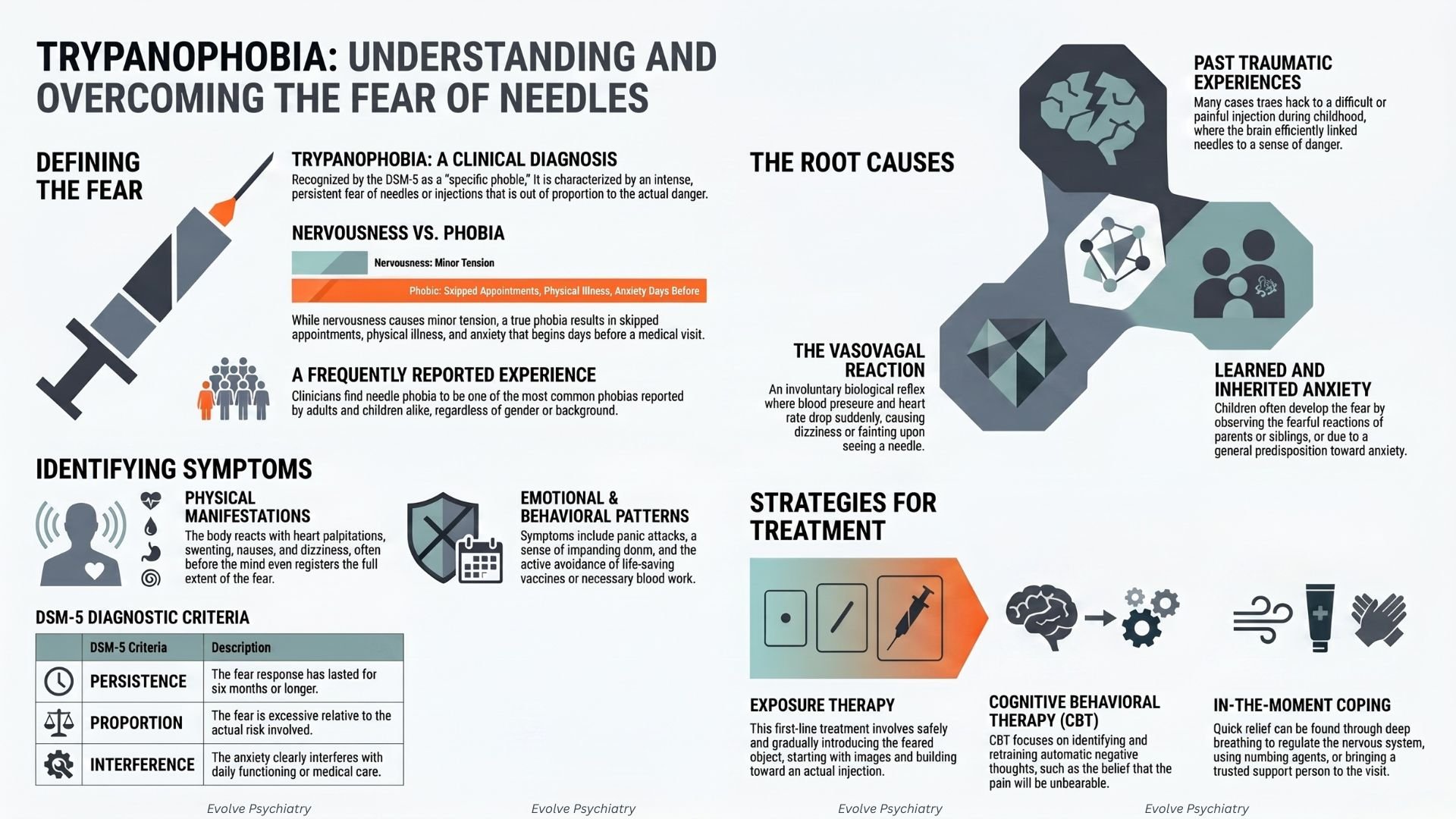
Everyone feels a small flinch at the sight of a needle. That is normal. A true fear of needles, however, is different. It involves intense anxiety that shows up well before the appointment, sometimes days in advance, and does not fade with simple reassurance. Clinically, this is often described as needle phobia: a persistent, outsized fear response tied specifically to needles, injections, or blood draws.
The difference between nervousness and phobia is intensity and impact. Nervousness might mean a tense shoulder. Needle phobia might mean canceling appointments, avoiding vaccines, or feeling physically ill for hours afterward. Recognizing where you fall on that spectrum matters because it shapes what kind of help will actually be useful.
Also Read: What is Phobia?
2.2 Is It a Diagnosable Condition?
Needle phobia has an official clinical name: trypanophobia. It falls under the broader category of specific phobia in the DSM 5, the diagnostic manual mental health professionals use to identify and classify conditions. Specific phobias are marked by intense, persistent fear of a particular object or situation that is out of proportion to the actual danger involved.
Because trypanophobia is medically recognized, it is not something to feel embarrassed about or push through alone. A mental health professional can assess whether your experience meets the criteria for a specific phobia, which opens the door to treatment options designed specifically for this kind of fear rather than general anxiety advice.
Also Read: How Phobias Develop?
2.3 How Common Is It?
Fear of needles is far more widespread than most people realize. It shows up in children getting routine vaccines, teenagers facing first blood draws, and adults who have avoided medical care for years because of it. Many people carry this fear quietly, assuming they are the only one who feels this way.
That assumption is part of what keeps people stuck. Shame around needle phobia often prevents people from asking for help, which only deepens the avoidance over time. Knowing that this fear is common, treatable, and well understood by mental health professionals can make it easier to finally talk about it.
Clinicians who study specific phobias consistently find fear of needles among the most frequently reported, regardless of age, gender, or background. It is not a niche concern, it is a shared human experience that simply does not get discussed openly very often.
Also Read: What Are the Common Types of Phobias?
3. What Causes Fear of Needles
3.1 A Traumatic Experience in the Past
For many people, fear of needles traces back to one specific traumatic experience: a painful injection as a child, a difficult vaccine appointment, or an unexpected needle stick during a procedure. The brain is efficient at linking pain to context, and a single hard moment can create a lasting association between needles and danger.
This is especially true if the experience happened during childhood, when coping skills are still developing. A child who was held down for a shot or surprised by pain may carry that memory into adulthood without consciously remembering the original event, only the fear it left behind.
3.2 The Body's Vasovagal Reaction
Part of what makes needle phobia so physically intense is a vasovagal reaction. This is an involuntary nervous system response where blood pressure and heart rate drop suddenly, leading to dizziness, light-headedness, and sometimes fainting. It is not a sign of weakness, it is a wired-in physiological reflex that some people are simply more prone to.
This reaction can create a frustrating cycle. The fear of needles raises anxiety, the anxiety triggers a vasovagal response, and the fainting or near-fainting experience then reinforces the original fear. Understanding this biological piece helps explain why willpower alone rarely resolves the problem.
3.3 Learned and Inherited Anxiety
Fear of needles is not always rooted in personal experience. Watching a parent or sibling react fearfully to injections can teach a child, often without words, that needles are something to dread. Children absorb emotional cues from caregivers long before they can explain why.
A general tendency toward anxiety can also play a role. People who experience anxiety in other areas of life may be more likely to develop an intense fear response to needles specifically, since their nervous system is already primed to react strongly to perceived threats.
4. Recognizing the Symptoms
4.1 Physical Symptoms
The body often reacts to needle phobia before the mind fully registers the fear. Common physical symptoms include heart palpitations, sweating, nausea, and dizziness in the moments leading up to or during a blood draw or injection. Some people experience fainting, particularly when the vasovagal reaction is strong.
These symptoms can feel alarming, especially if they show up suddenly. Recognizing them as part of a known pattern, rather than a sign that something is seriously wrong, can reduce some of the panic in the moment and make the experience feel more manageable.
4.2 Emotional and Behavioral Symptoms
Beyond the physical response, fear of needles often brings emotional and behavioral symptoms. Many people experience a full panic attack: racing thoughts, a sense of doom, and an overwhelming urge to leave the room. Others develop avoidance patterns, delaying or skipping vaccines, blood work, or necessary medical procedures altogether.
This avoidance can have real consequences for physical health over time. Recognizing avoidance as a symptom, rather than simply a personal preference, is an important step toward addressing the fear directly instead of working around it indefinitely.
4.3 When It Crosses into a Phobia
Occasional nerves before an injection are normal and do not necessarily require treatment. Fear of needles crosses into a true specific phobia when the anxiety is intense, persistent, and disruptive enough to interfere with getting medical care. If the fear leads to cancelled appointments or delayed treatment for other health conditions, it has moved beyond ordinary nervousness.
This distinction matters because it determines next steps. A phobia at this level benefits from structured treatment, not just personal reassurance or trying to power through it alone.
5. How Fear of Needles Is Diagnosed
5.1 Talking to a Mental Health Professional
Diagnosis typically begins with an honest conversation. A mental health professional will ask about when the fear started, how intense it feels, and how it affects daily life and medical care. This conversation is not about judgment, it is about understanding the full picture so treatment can be tailored to you.
Sharing details like past traumatic experiences, physical symptoms, or patterns of avoidance helps the clinician understand whether this is a standalone fear or connected to broader anxiety.
5.2 Diagnostic Criteria Clinicians Use
Clinicians use the DSM 5 criteria for specific phobia to guide diagnosis. This generally involves marked fear that is excessive relative to the actual risk, a fear response that has lasted six months or longer, and clear interference with daily functioning. For needle phobia, this might mean avoiding necessary blood draws or vaccines for years.
A proper diagnosis is not about labeling someone, it is about opening the door to treatment options that are proven to work for this specific type of fear.
Also Read: How Therapists Diagnose a Phobia?
6. Treatment and Coping Strategies
6.1 Exposure Therapy
Exposure therapy is widely considered one of the most effective treatments for needle phobia. It works by gradually and safely introducing the feared object or situation, starting with something low intensity, like looking at a picture of a needle, and slowly building toward an actual injection, all at a pace the person can tolerate.
This gradual process helps retrain the nervous system's response over time. Rather than avoiding the trigger, the brain learns through repeated, manageable exposure that the feared outcome does not occur, which steadily reduces the fear response.
6.2 Cognitive Behavioral Therapy (CBT)
Cognitive behavioral therapy, or CBT, addresses the thought patterns that fuel needle phobia. A therapist helps identify automatic thoughts like “this will be unbearable” and works with the patient to develop more balanced, realistic responses. CBT often pairs well with exposure therapy for a more complete treatment approach.
This combination treats both the mental and physical sides of the fear: the racing thoughts that spark a panic attack and the avoidance behaviors that keep the fear alive.
6.3 Medication and In-the-Moment Coping
For some people, short-term medication prescribed by a provider can ease anxiety enough to get through a necessary procedure while longer-term therapy is underway. This is not a permanent fix, but it can be a useful bridge.
In-the-moment coping strategies also help. A numbing agent applied before an injection can reduce physical discomfort, while deep breathing slows the body's stress response. Bringing a trusted support person to appointments can provide reassurance and a sense of safety, making the entire experience feel less overwhelming.
Also Read: Exposure Therapy for Phobia Treatment
7. Frequently Asked Questions about Fear of Needles
7.1 Is fear of needles a real medical condition?
Yes. Fear of needles, clinically known as trypanophobia, is recognized as a type of specific phobia in the DSM 5. It is a legitimate mental health condition, not a personal weakness, and it responds well to established treatment approaches.
7.2 Why do some people faint at the sight of a needle?
Fainting is usually caused by a vasovagal reaction, an involuntary drop in blood pressure and heart rate triggered by fear or pain. This physical response is common with needle phobia and can often be reduced through gradual exposure and relaxation techniques.
7.3 Can children outgrow needle phobia?
Some children's fear lessens naturally as they mature and gain more positive medical experiences. However, fear that remains intense or leads to avoidance often needs structured support, since waiting it out alone does not always resolve a true phobia.
7.4 What's the fastest way to calm down before an injection?
Deep breathing is one of the quickest tools available in the moment. Focusing on slow exhales helps regulate the nervous system. Bringing a support person and asking about a numbing agent beforehand can also ease both the physical and emotional response.
7.5 Can fear of needles be treated without medication?
Yes. Exposure therapy and cognitive behavioral therapy are considered first-line, non-drug treatments for needle phobia, and many people see significant improvement through these approaches alone. Medication is sometimes used short-term, but it is not required for lasting progress.
8. Finding Support to Overcome Fear of Needles
Living with fear of needles does not mean you are stuck this way forever. With the right combination of exposure therapy, cognitive behavioral therapy, and practical coping strategies, most people see real, lasting improvement. The first step is simply reaching out for support instead of carrying the fear alone.
Evolve Psychiatry's clinical team understands how much courage it takes to ask for help with a fear that often goes unspoken. Whether you are dealing with needle phobia on its own or alongside broader anxiety, treatment is available close to home, with providers who take your experience seriously from the very first appointment.
Evolve Psychiatry offers in-person care at six clinics across New York and North Carolina:
Reaching out is the step that makes overcoming this fear possible, and our team is ready to walk through that process with you, one manageable step at a time.
